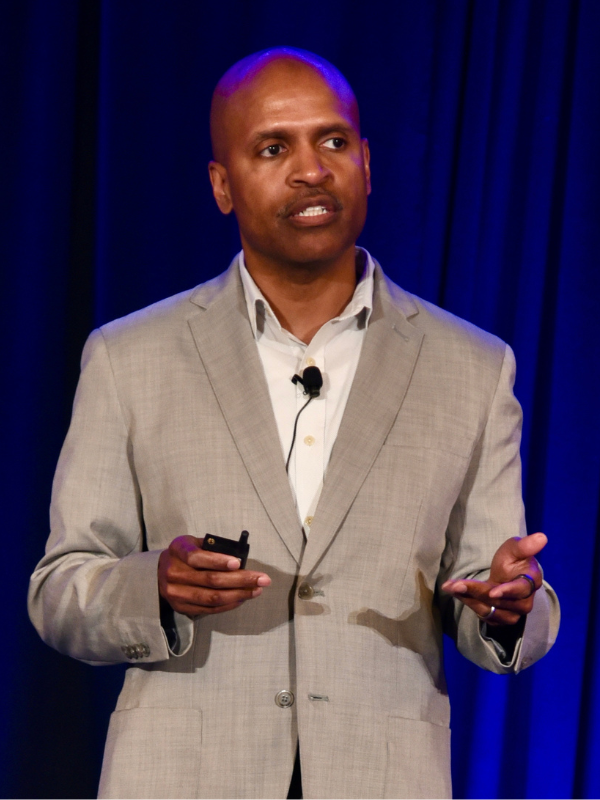
Chicago physician Tony Hampton returns to San Diego with a practical message: Ketosis is a tool, not the trophy
For Dr. Tony Hampton, the question is not whether ketosis matters.
It does.
The harder question — and the one he believes deserves a more careful answer — is when it matters, why it matters and when chasing ketone numbers can distract people from the larger goal of healing.
That will be the focus of Hampton’s presentation, “When Ketosis Matters: Separating Metabolic Therapy from Metabolic Hype,” at the 11th annual Symposium for Metabolic Health, Aug. 13-16, 2026, at the Wyndham San Diego Bayside Hotel.
The event, hosted by LowCarbUSA® in collaboration with the Society of Metabolic Health Practitioners, brings together clinicians, researchers, health coaches and members of the public for four days of education focused on therapeutic carbohydrate reduction, metabolic health and chronic disease.
Hampton, a family physician, obesity medicine specialist, author and longtime advocate for root-cause medicine, is returning to the San Diego symposium as one of its most familiar and popular voices. His message this year is aimed at both sides of a debate that often gets flattened online.
Some people treat ketosis as the ultimate proof that a low-carb or ketogenic diet is working. Others dismiss it as irrelevant or overhyped.
Hampton thinks both views miss the point.
“In social media, they talk about ketosis like it’s the golden egg,” Hampton said. “Like if you’re not in ketosis, something’s wrong.”
His goal in San Diego is to slow that conversation down.
“Ketosis can and will be important in certain contexts, but it’s not the trophy,” he said. “The goal is to achieve metabolic health for most people, and healing is the trophy.”
The number is not the goal
Hampton said his clinical conversations rarely begin with ketosis.
“In my clinical practice, we don’t really talk about ketosis hardly at all,” he said. “We talk about things like carbohydrate tolerance. We talk about inflammation. We talk about food quality. We talk about cravings. And we talk about the root cause of why you get sick.”
That distinction matters because many patients come into metabolic health already burdened by failure. They have tried diets. They have been told to eat less and move more. They have watched blood sugar, weight, blood pressure or inflammation remain stubbornly high despite sincere effort.
Adding another number to obsess over, Hampton said, can compound the problem.
“People get confused,” he said. “They sometimes think they’re failing if they don’t get their ketone number right.”
For Hampton, the better clinical question is not whether someone’s beta-hydroxybutyrate level is high enough on a meter, but rather what are the goals of the patient and practitioner.
“The question shouldn’t be necessarily, how high are your ketones,” he said. “The better question is, what problem are we trying to solve?”
For many patients, the problems include type 2 diabetes, obesity, fatty liver disease, Polyendocrine Metabolic Ovarian Syndrome (PMOS), metabolic syndrome and insulin resistance. In those cases, Hampton said, the focus is often better placed on food quality, carbohydrate tolerance, lowering insulin, improving satiety, reducing cravings and addressing the broader set of factors that drive metabolic dysfunction.
When ketosis becomes therapeutic
That does not mean Hampton minimizes ketosis.
In some medical contexts, he said, ketosis can be central to the therapeutic strategy. He points to epilepsy, including his wife’s own experience before brain surgery helped bring her seizures under control, as one of the clearest examples. He also cites conditions such as GLUT1 deficiency and neurologic disorders where ketogenic therapy may play an important role.
That is where the nuance matters.
Hampton wants attendees to understand the difference between ketosis as a targeted metabolic therapy and ketosis as an online scoreboard. He also plans to address one of the most persistent points of confusion: Nutritional ketosis is not diabetic ketoacidosis.
“That term ketosis is not the same as diabetic ketoacidosis,” he said. “Nutritional ketosis … is not the same as diabetic ketoacidosis, and I think that’s important.”
He also wants to challenge the assumption that higher is always better.
“There’s this misconception about the more ketones I have in my body, the better,” Hampton said. “And that’s just not really true.”
If a patient has a normal A1C, strong triglyceride-to-HDL ratio and improving metabolic markers, he said, a very high ketone reading may not add much. The goal is not to win a ketone contest. The goal is to restore health.
A physician who speaks plain language
Part of Hampton’s appeal at the Symposium is his ability to translate complex physiology into language people can use. He is comfortable discussing mitochondria, insulin resistance and beta-hydroxybutyrate, but he does not believe most patients need to begin there.
“Most people who hear us talk are not Ph.D.s and doctors,” Hampton said. “They’re just people who are not necessarily excited about mitochondria and beta-hydroxybutyrate … You want to speak the language of the person.”
That communication style is also shaping his forthcoming book, “Breaking Up with Obesity,” which Hampton said he expects to be ready around the time of the symposium. Unlike his first book, “Fix Your Diet, Fix Your Diabetes,” the new book uses characters to tell the story of metabolic health.
One character, Annie, is named after his mother. Others represent different struggles, backgrounds and eating patterns. Hampton said the book is designed to make room for people with a range of dietary approaches while still returning to the same central theme: reducing the foods and patterns that spike glucose, insulin and inflammation, and helping people build a life that supports healing.
The book is built around Hampton’s N.E.S.T. and R.O.P.E. framework, which examines nutrition, exercise, stress and sleep, thoughts and trauma, relationships, organisms, pollutants, emotions and life experiences. It is his way of moving the conversation beyond food alone without minimizing food’s importance.
Hampton’s diet may be carnivore, but his clinical philosophy is not about forcing everyone into one lane.
“This book will have space for all types of eating patterns,” he said. “I’ve learned that you really have to meet people where they are.”
From food pharmacy to smart farm
Hampton’s work is not confined to books, podcasts or conference stages.
Within Advocate Health in Chicago, he has helped lead food pharmacy and mobile health efforts designed to make healthier choices more accessible to patients and communities. He said the food pharmacy concept began years ago at one hospital and has since expanded to multiple sites.
At Advocate Sherman Hospital, the work has gone even further.
“Imagine pulling up to a hospital, and the first sign you see is a smart farm,” Hampton said. “Imagine pulling up to a hospital where HR has to see applications coming in for farmers.”
The hospital now has employed farmers, a smart farm and a smart farm kitchen, Hampton said, where patients and community members can learn how to prepare healthier meals. The program supplies food not only to the food pharmacy but also to the community.
For Hampton, this is more than a nice community project. It is part of a larger attempt to test whether food-as-medicine programs can move measurable health outcomes.
He said the team is preparing a quality improvement project, with formal research expected to follow in 2027. Participants will receive food along with educational videos, QR-code access and weekly instruction over roughly six months.
The language will be intentional.
“I can’t come through the door … and say keto or carnivore, because that’ll spook some of our doctors,” Hampton said.
Instead, he plans to talk about metabolic health, low-glycemic meal plans and high-satiety foods. The goal is not to win an ideological argument. It is to bring the principles of metabolic health into a large health system in a way conventional clinicians, dietitians, administrators and patients can hear.
Bringing symposium ideas into health care
That is one reason Hampton believes the Symposium for Metabolic Health matters.
For patients, the event offers access to clinicians and researchers who are thinking deeply about the root causes of chronic disease.
For practitioners, it offers practical tools, current science and a community of peers who are trying to move beyond managing disease with medication alone.
For Hampton, the symposium is also a bridge between a passionate metabolic health community and the larger health care systems where most patients still receive care.
“I’m in a season of philanthropy, and just giving back,” Hampton said. “I’m just trying to bring what we do at the symposium to a large health system.”
That effort fits the broader mission of LowCarbUSA and the SMHP, which have worked to create a professional home for clinicians and allied health professionals interested in therapeutic carbohydrate reduction, metabolic health and evidence-based lifestyle interventions.
The San Diego symposium is designed for physicians, nurses, dietitians, health coaches, researchers and health-conscious members of the public.
Attendees can join in person or via on-demand livestream.
The ACCME-accredited event brings together leading voices in metabolic health, therapeutic carbohydrate reduction, obesity, diabetes, cardiovascular health, clinical care and nutrition science for an evidence-based look at the metabolic drivers of chronic disease.
But Hampton’s return to San Diego is also a reminder that science alone is not enough. The information has to reach people. It has to be translated into clinical practice.
It has to be made useful for the person sitting in the exam room who is tired, confused, hungry, discouraged and trying to get better.
Why this talk matters now
Hampton’s talk arrives at a moment when ketosis has become both more visible and more misunderstood.
Meters, supplements, social media challenges and online communities have made it easier than ever for people to track ketones. That can be useful. It can also become another source of anxiety, especially when people lose sight of why they are measuring in the first place.
Hampton is not asking people to stop caring about ketosis. He is asking them to understand it.
For someone using ketogenic therapy for epilepsy or another neurologic condition, ketosis may be a key part of the treatment plan. For someone trying to reverse insulin resistance, improve blood sugar, reduce cravings or restore metabolic health, ketone readings may be useful feedback — but not the destination.
The distinction is the heart of his presentation.
Ketosis is a tool. Metabolic health is the aim. Healing is the trophy.
Join Dr. Tony Hampton in San Diego
The 2026 Symposium for Metabolic Health will take place Aug. 13-16 at the Wyndham San Diego Bayside Hotel. In-person and livestream tickets are available, with clinicians, researchers, health coaches and patients gathering for four days of education, connection and practical strategies for addressing obesity, type 2 diabetes, cardiovascular disease, neurologic and mental health conditions, insulin resistance, inflammation and other drivers of chronic disease.
Hampton’s presentation, “When Ketosis Matters: Separating Metabolic Therapy from Metabolic Hype,” will be especially relevant for anyone who has ever wondered whether their ketone number is high enough, whether ketosis is necessary for success or how to distinguish therapeutic ketogenic care from online noise.
For those who can attend in person, San Diego offers something livestreams cannot fully recreate: the conversations between sessions, the chance to ask questions directly, and the experience of being surrounded by people who believe chronic disease is not inevitable and better health is possible. Attendees also have the opportunity to purchase tickets for two exceptional low-carbohydrate dinners, where master chefs prepare unforgettable meals enjoyed under the stars alongside symposium presenters, colleagues and fellow attendees—an experience that has become one of the most anticipated traditions of the event.
Learn more about the 2026 San Diego Symposium for Metabolic Health and register today!