
The physician and researcher will use MRI imaging, visceral fat and other health metrics to challenge how we measure progress at the 2026 Symposium for Metabolic Health
Most attempts to improve health begin with numbers.
Weight. Waist circumference. Blood pressure. Blood glucose. Cholesterol. Maybe a body-fat percentage or a fitness test.
Dr. Sean O’Mara wants people to look deeper.
At the 2026 Symposium for Metabolic Health in San Diego, Dr. O’Mara will make the case that some of the most meaningful evidence about a person’s metabolic health may be hidden beneath the surface — and that seeing those changes can fundamentally alter how people approach their health.
Dr. O’Mara, MD, JD, is a physician, researcher and former U.S. Army colonel whose work focuses on visceral fat, fat surrounding the heart and fat infiltrating skeletal muscle. His career has also included work as an undercover narcotics officer, criminal prosecutor and emergency physician, and today he works with executives, political leaders, public figures and other high performers seeking measurable improvements in health and performance.
His presentation, “Seeing Metabolic Disease: Advanced Imaging, External Phenotype, and Information-rich Metrics for Biological Optimization,” is scheduled for 1:45 p.m. Saturday, Aug. 15.
Dr. O’Mara has built much of his work around the use of MRI imaging to examine visceral fat, fat surrounding the heart and fat infiltrating skeletal muscle.
His larger argument is deceptively simple: If you are trying to improve something, you should be able to measure whether it is actually improving.
“If you want to sprint faster, you need to track your time,” Dr. O’Mara said. “If you want to get healthy, you need to track something. And what is it you’re going to track?”
Looking Beneath the Surface
Dr. O’Mara’s interest in MRI goes beyond its ability to produce sophisticated images.
He believes the images themselves can become a powerful source of feedback.
Traditional health assessments often leave patients with a report filled with measurements and reference ranges. Dr. O’Mara wants them to see what is happening inside their bodies — particularly changes in muscle and unhealthy fat deposits.
MRI is his preferred imaging technology because it does not expose patients to ionizing radiation. CT imaging can be used when an MRI is contraindicated, he said.
But the distinction Dr. O’Mara emphasizes is not merely technical. It is psychological.
He compares it with the instinct of someone finishing a hard set of weights and immediately looking in the mirror. The person wants evidence that the work is accomplishing something.
Dr. O’Mara believes metabolic health should provide the same kind of feedback.
Rather than simply being told that a number improved, he wants patients to be able to compare images and see less visceral fat, less fat surrounding organs and more healthy muscle.
That visible evidence, he argues, can reinforce behavior in a way a laboratory report sometimes cannot.
Why Visceral Fat Matters So Much
Visceral fat — the fat stored deep within the abdominal cavity and around internal organs — will occupy a prominent place in Dr. O’Mara’s San Diego presentation.
While much of modern weight-loss culture remains focused on the fat people can see, Dr. O’Mara is far more concerned about the fat they cannot see.
“So visceral fat is just an enormous impediment,” Dr. O’Mara said. “It’s structural disease, and I’ll talk more about it in the presentation.”
Dr. O’Mara describes visceral fat and related fat deposits around the heart and within muscle as markers of what he calls structural disease. Tracking those deposits, he argues, gives clinicians another way to evaluate whether an intervention is moving a patient toward or away from better metabolic health.
That emphasis has also shaped Dr. O’Mara’s approach to individualized care.
Rather than assuming that a strategy is beneficial simply because it is generally considered healthy, he wants to know what happens when a particular person actually implements it.
“I don’t really care about what’s happening to other people, and I don’t care what’s happening in scientific studies,” Dr. O’Mara said. “You know what I care about? What’s happening to you.”
Dr. O’Mara does not mean that he ignores scientific research; he describes himself as a physician-researcher who reads studies regularly.
His point is that individual outcomes matter, too.
When working with a client, he wants objective feedback capable of showing whether the chosen intervention is producing the desired result.
The Body Leaves Clues
Some of the metrics in Dr. O’Mara’s presentation will be considerably easier to see than an MRI.
He pays close attention to what he calls the external phenotype — physical characteristics that he believes can change alongside improvements in metabolic health.
His list is unusually detailed: eyelids, eyelashes, nasal appearance and flaring, nasolabial folds, skin creases, fingernails, toenails, spider veins and skin turgor, among many others.
Where another observer might see incidental details, Dr. O’Mara sees potential information.
It is part of a broader philosophy running through his work: Metabolic health should not remain an abstraction.
Look for signals. Establish a baseline. Make an intervention. Then look again.
For people who have spent years hearing that chronic disease is simply something to manage, that approach can also restore something less quantifiable: the expectation that meaningful improvement is still possible.
Dr. O’Mara says he has seen substantial changes among clients in their 50s, 60s and beyond — an age when many people have begun accepting physical decline as inevitable.
Sprinting, Strength and Efficiency
That same obsession with measurable results has led Dr. O’Mara toward another subject for which he has become well known: sprinting.
His recommendations are not one-size-fits-all. For an appropriately prepared individual, however, he described a general starting framework of roughly six maximum-intensity efforts lasting about 10 to 15 seconds each, separated by enough recovery to produce another high-quality effort.
Dr. O’Mara argues that very intense muscular work creates a powerful biological signal, and he points to emerging research into exercise-induced signaling molecules, including Lac-Phe, as one possible mechanism connecting intense exercise with changes in appetite, fat and metabolism.
His critique of high-volume endurance exercise is likely to be among the more provocative elements of his message. Dr. O’Mara argues that more exercise is not automatically better and prefers using imaging and other measures to evaluate what different forms of activity are actually doing to an individual.
The underlying theme is efficiency.
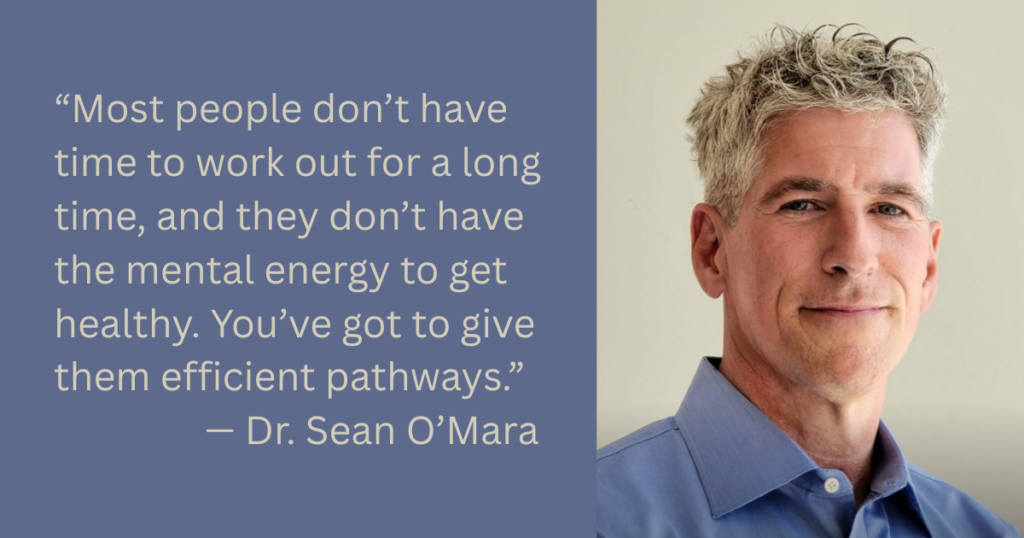
“We have to get these people healthy,” Dr. O’Mara said. “Most people don’t have time to work out a long time, and they don’t have the mental energy, you know, to get healthy. So, what I’ve learned over 18 years of doing this, is you’ve got to give them efficient pathways. You’ve got to cut out the nonsense and the waste of time.”
For someone trying to reverse decades of declining health, a program that demands hours of exercise may look impressive on paper and still fail in practice.
Dr. O’Mara would rather identify the smallest effective dose that produces measurable change — and then verify that it is working.
Removing What Is Working Against You
Exercise, however, is only one piece of the equation.
When asked what else people should address to reduce visceral fat, Dr. O’Mara quickly turned to food.
His analogy was blunt: Someone can exercise, lift weights and make other positive changes while simultaneously “pouring gasoline on the fire” through a diet dominated by processed foods.
For Dr. O’Mara, reducing that exposure is foundational. It is also one reason his message has found a natural audience within the low-carbohydrate community.
His own experience with carbohydrate reduction has only strengthened that conviction.
“The more I cut out carbohydrates, the better I got, and the more I get people to cut out carbohydrates, the better I see they get,” Dr. O’Mara said. “And so I love the low carb community, and I love LowCarbUSA.”
Why San Diego Matters
That affinity is part of what is bringing Dr. O’Mara to the Symposium for Metabolic Health.
The Aug. 13-16 event, hosted by LowCarbUSA in collaboration with the Society of Metabolic Health Practitioners at the Wyndham San Diego Bayside Hotel, will bring together clinicians, researchers and members of the public for four days devoted to metabolic health and chronic disease.
Dr. O’Mara said the scientific seriousness of the organization — including its effort to bring continuing medical education into the conversation — matters to him.
“I love the low carb community, and I love LowCarbUSA. What it’s trying to do to get this message out, and they’re also doing it in a serious way,” Dr. O’Mara said.
For Dr. O’Mara, the stakes extend well beyond carbohydrate intake or any single health metric.
He views metabolic health as a way of preserving what people are capable of doing — whether they are leading organizations, raising families, practicing medicine, creating art or simply trying to remain strong and independent as they age.
And that may be the most important idea behind his upcoming presentation.
Improving health requires action. But action without feedback can quickly become guesswork.
Dr. O’Mara wants people to look for evidence.
Measure what matters. Look beneath the surface. Find out whether the intervention is working.