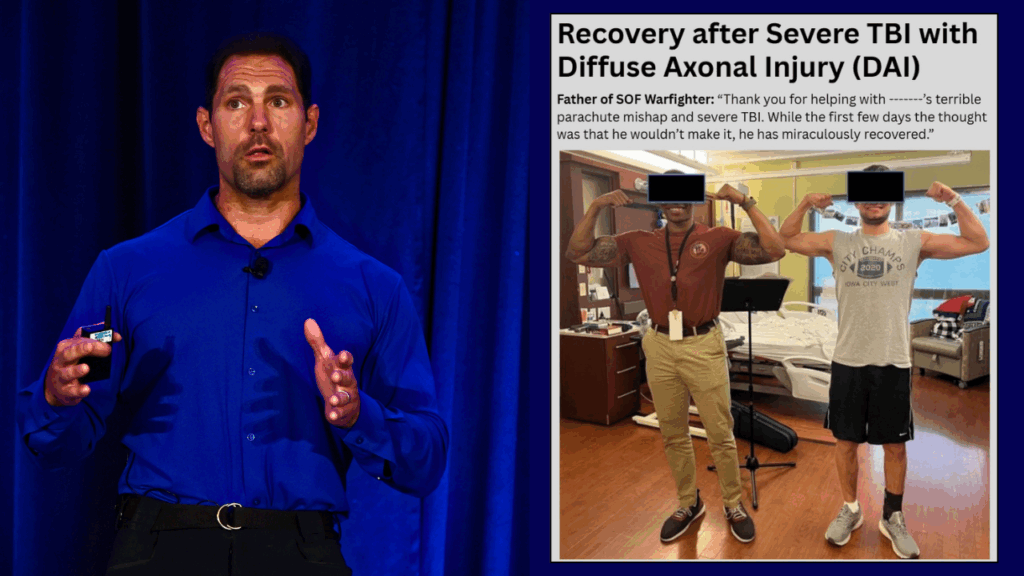
At last month’s 10th Annual San Diego Symposium for Metabolic Health, neuroscientist Dr. Dominic D’Agostino delivered a very impactful and important presentation of the weekend. His lecture, “Traumatic Brain Injury: Mechanisms and Metabolic-Based Treatments,” challenged us to rethink the way brain injuries are treated—and the opportunities we are missing.
“When a patient comes in who has sustained a traumatic brain injury, you really need to stick to first principles,” he told the audience. “Airway, breathing, circulation. But I think there’s a really great opportunity that’s missed—metabolic therapies could be done as part of the ABCs.”
Dr. D’Agostino argued that traumatic brain injury is best understood as a metabolic crisis. “Traumatic brain injury is a neuro-metabolic dysregulation issue,” he said. “There’s neuroinflammation, blood flow issues, hypoxia, and failed glucose metabolism in the brain. Ketones can rescue brain energy metabolism in these situations.”
He didn’t just speak in theory—he shared powerful stories. “This is a person I was connected with, a special operations war fighter,” said D’Agostino, as he gestured toward the screen. “His parachute did not open. About six or seven months before this picture was taken, he was in a coma. His father sent me an email: ‘Thank you for helping my son.’ He was moved to the Tampa VA hospital, and the polytrauma team there basically brought him back to life. He’s fully operational now—no signs of traumatic brain injury.”
Dr. D’Agostino also emphasized how much is at stake: “Upwards of 77% of people with severe, moderate TBI have a psychiatric illness. Depression, substance abuse, anxiety—these are not being addressed in rehabilitation or follow-up.”
And he offered hope for patients and clinicians alike. “Ketones are neuroprotective, cardioprotective, anti-inflammatory, and anti-catabolic. They enhance mitochondrial function and resilience. This is really the recipe for recovery.”
His presentation, like so many others in San Diego, reinforced why these gatherings are so valuable—bringing together clinicians, researchers, and community members to share insights that can change lives.
If you missed San Diego, recordings of the full program are still available here, with up to 28 optional CME credits: San Diego 2025 Recordings »
Our Symposium for Metabolic Health in Boca Raton (January 23-25, 2026) will deliver multiple days of expert talks, discussions, and practical sessions from clinicians and scientists pushing the frontier on metabolic, cardiovascular, full body, and brain health.