The neuroscientist and former chronic migraineur will share her five-pillar approach to migraine, mitochondrial health and brain energy metabolism at the Symposium for Metabolic Health
Long before Elena Gross, PhD, became a neuroscientist, clinical researcher and founder of a health technology company, she was a frightened 14-year-old trying to understand why she was waking from sleep with excruciating, one-sided headaches.
The attacks initially occurred infrequently, but the uncertainty was terrifying. Dr. Gross and her family wondered whether she had a brain tumor. It took more than a year of doctor visits, brain scans and other evaluations before she finally received a migraine diagnosis.
The diagnosis provided a name, but not a solution.
Dr. Gross tried pharmaceuticals, acupuncture, Chinese herbal medicine and other approaches. Nothing stopped the attacks from becoming more frequent. By the time she was an undergraduate student, she was experiencing pain 20 to 30 days a month.
She missed classes, school trips, parties and many of the ordinary experiences that shape a young person’s life. Teachers sometimes questioned whether she was truly sick. Friends stopped inviting her to events because they assumed she would be unable to attend.
“I was missing out on life,” Dr. Gross said. “It was really bad to be out of control. It was bad not to be taken seriously.”
That experience eventually changed the direction of her education, her career and her life.
Dr. Gross will share what she has learned during her presentation at the 11th annual Symposium for Metabolic Health, taking place Aug. 13-16 at the Wyndham San Diego Bayside.
From Migraine Patient to Neuroscientist
Dr. Gross was fascinated by the brain even before her migraines became chronic. She began studying psychology but switched to neuroscience when it became clear that her condition could prevent her from holding a conventional job or living the life she had imagined.
She decided that, even if she could not solve her own migraines, she could devote her career to understanding them.
While completing a master’s degree in neuroscience at the University of Oxford in 2014, Dr. Gross came across research involving the ketogenic diet, one of the oldest treatments for epilepsy.
She already understood that epilepsy and migraine share certain neurological and genetic characteristics. As she learned more about ketone bodies, brain excitability and energy metabolism, she began to wonder whether ketogenic interventions might also have applications in migraine.
Oxford officials considered the research too uncertain for her doctoral work, Dr. Gross said. She began searching for another laboratory and eventually moved to Basel, Switzerland, where researchers allowed her to investigate the idea through a pilot project.
Beginning in 2015, she helped conduct what she described as the first clinical trial examining the use of exogenous ketone salts in migraine patients. She later earned her doctorate in clinical research from the University of Basel and founded KetoSwiss after larger companies showed little interest in bringing the intervention to market.
Dr. Gross is now the founder and CEO of KetoSwiss and the creator of Brain Ritual, a medical food developed to support brain energy metabolism. She is also the inventor of four patents and has published research in journals including Nature Reviews Neurology.
But the work remains intensely personal.
Dr. Gross does not describe herself as cured. She can still experience a migraine when sleep deprivation, hormonal changes, alcohol, jet lag, oxidative stress or other factors increase her vulnerability. The difference is dramatic, however: Attacks that once occurred 20 to 30 days a month may now happen only once every month or two — and sometimes even less frequently.
“It’s really not an issue anymore, but it’s still there to warn me,” she said.
“Migraine Is the Messenger, Not the Mistake”
That warning has become central to the way Dr. Gross understands migraine.
Rather than viewing the attack as an inexplicable malfunction, she sees it as a signal that the brain is struggling to meet its energy needs or respond to an underlying physiological stressor.
“Migraine is the messenger, not the mistake,” she said.
Dr. Gross describes the brain as “the canary in the coal mine” because of its extraordinary energy requirements. Although it represents only a small percentage of the body’s mass, it consumes a disproportionately large share of its energy.
Unlike muscles and some other organs, the brain cannot easily store fuel or draw from a wide variety of energy sources. It depends on a continuous supply of small molecules capable of crossing the blood-brain barrier.
In a metabolically flexible person, those fuels may include glucose, lactate and ketone bodies. Dr. Gross argues that the modern combination of physical inactivity, frequent eating, poor metabolic health and limited ketone production can leave the brain increasingly dependent on glucose alone.
“When we’re energy deficient, the brain tends to suffer first,” she said.
That does not mean Dr. Gross believes every migraine has the same origin or that ketosis is a universal treatment. Hormonal deficiencies, nutrient deficiencies, oxidative stress and other factors may play different roles in different people.
Her position is more nuanced: A meaningful subset of migraine patients may benefit when clinicians investigate metabolic and physiological contributors rather than focusing exclusively on suppressing pain.
A Five-Pillar Model for Mastering Migraine
Dr. Gross’s San Diego presentation will draw from the five-pillar model described in her book, How to Master Migraine. The model is intended to help practitioners and patients look beyond a single diet, supplement or medication and examine the interconnected factors that influence brain energy and migraine susceptibility.
The first pillar focuses on individualized micronutrients. Vitamins, minerals, trace elements and coenzymes are required to produce energy, regardless of whether that energy originates from glucose, fatty acids or ketone bodies.
The second addresses oxidative stress and antioxidant capacity. Excessive oxidative stress can impair mitochondrial function and interfere with energy production.
The third explores other ways to support mitochondrial health, including sleep, oxygen availability, circadian rhythm, daylight exposure, physical positioning, sauna, cold exposure and related lifestyle factors.
The fourth focuses on blood sugar and stress-hormone stability. Dr. Gross discusses low-carbohydrate and low-glycemic dietary strategies, fasting, food sensitivities, artificial sweeteners, cortisol and other factors capable of influencing glucose variability.
The fifth pillar examines alternative energy sources for the brain, including ketogenic diets, exogenous ketones and short-chain fatty acids produced by the gut microbiome.
Dr. Gross emphasizes that there is no single ketogenic template appropriate for everyone. Some people may use a strict ketogenic diet. Others may follow a lower-carbohydrate paleo approach, cycle in and out of ketosis, consume carbohydrates later in the day or use exogenous ketones while following a whole-food diet.
Her own diet has evolved. Dr. Gross no longer follows a strict ketogenic diet and describes her current approach as low-glycemic, whole-food and paleo-influenced, supplemented with exogenous ketones.
“Ketosis is one aspect,” she said. “It’s not everything.”
Extinguishing the Fire, Not Silencing the Alarm
Dr. Gross understands why conventional medicine often concentrates on symptoms. Clinicians working within short appointments may have only enough time to identify a complaint and prescribe a medication intended to control it.
But she believes chronic disease requires a deeper investigation.
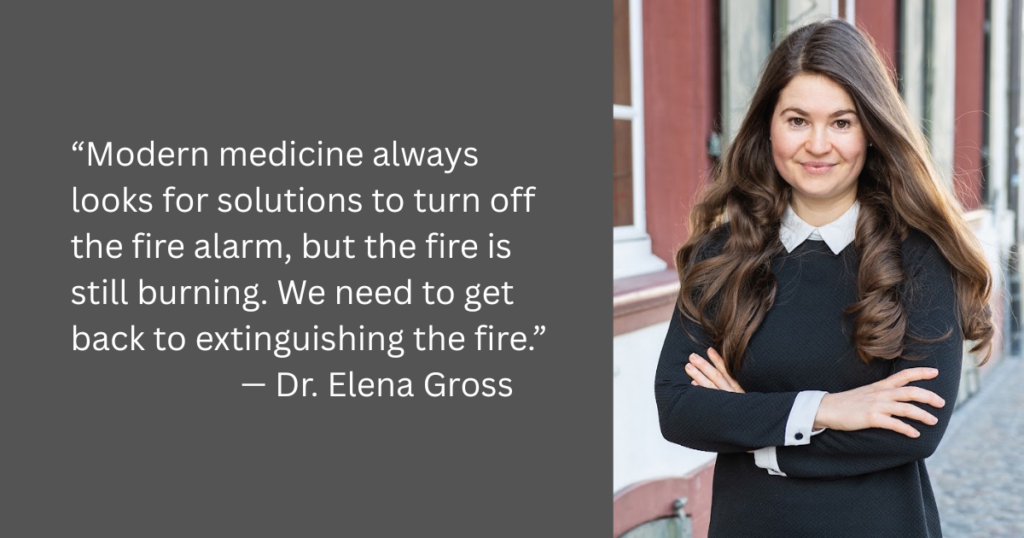
She compares the process to a fire alarm sounding inside a burning house. The alarm is painful and disruptive, so the immediate impulse is to silence it. Turning off the alarm, however, does nothing to extinguish the fire.
“Modern medicine always looks for solutions to turn off the fire alarm, but the fire is still burning,” Dr. Gross said. “We need to get back to extinguishing the fire.”
Her own experiences also taught her how damaging it can be when patients are dismissed because their symptoms cannot yet be fully explained.
“The patient is always right, and I think they need to be taken seriously,” she said. “The patient knows the disease the best.. So we need to incorporate them into a treatment plan. We need to look for root causes.”
That message may resonate with people living with conditions that have been labeled chronic, progressive or unavoidable.
Dr. Gross does not promise that every disease can be reversed or that every patient will respond to the same intervention. She argues instead that people should not assume a condition is genetically predetermined simply because it is common.
Diet, movement, sleep, stress, nutrient status, environmental exposures and social surroundings are all parts of the environment in which genes are expressed. Changing that environment may give patients and practitioners additional levers to pull.
Dr. Gross also cautions the metabolic health community against presenting ketogenic therapy as a cure for every condition. Her research increasingly focuses on metabolic subtypes of neurological and psychiatric conditions — the possibility that some cases of migraine, depression, Alzheimer’s disease and other disorders have a stronger metabolic component than others.
The field will earn greater trust, she said, by acknowledging both the people who respond dramatically and those who may require a different approach.
The Simplicity of an Intervention Does Not Determine Its Power
One of the misconceptions Dr. Gross encountered as a teenager was the belief that an illness capable of causing such profound suffering could not possibly respond to changes in food, metabolism or lifestyle.
Surely, she thought, a problem that serious would require an equally powerful pharmaceutical solution.
“If something is so terrible, it cannot be fixed by something as simple as a lifestyle approach, and that couldn’t be further from the truth,” Dr. Gross said.
That does not make lifestyle change effortless. Identifying an effective strategy may require substantial experimentation, testing, education and support. Dr. Gross spent years refining her approach after discovering ketosis, addressing nutrient deficiencies and examining other factors that affected her mitochondrial health.
But the complexity of that process has only strengthened her conviction that patients deserve access to information that may help them participate more fully in their own care.
“Chronic disease symptoms are not a mistake; they’re the messenger,” she said. “We’re shooting the messenger. We shouldn’t.”
Why Dr. Gross Is Coming to San Diego
The 2026 symposium will be Dr. Gross’s first LowCarbUSA and Society of Metabolic Health Practitioners (The SMHP) event, but she has wanted to attend for years.
Earlier in her career, the cost of traveling from Europe made participation impossible. This August, she plans to bring several members of her team to San Diego, where KetoSwiss and Brain Ritual will also have an exhibitor booth.
Dr. Gross is looking forward to presenting her research, but she says the conversations that take place outside the lecture hall may be just as valuable.
“That’s the best part of the conferences,” she said. “It’s the people you meet. It’s the networking.”
She is particularly interested in meeting practitioners because of the number of patients each clinician may be able to reach.
“If we can convince practitioners to help their patients, then we already have a bigger impact,” she said.
She also wants to hear from researchers and clinicians working beyond migraine, including those investigating depression, neurological disease and other applications of metabolic therapy.
After years of feeling as though she was fighting alone, Dr. Gross sees a growing community of people asking similar questions.
“I’m still as enthusiastic, if not more, now than I was,” she said. “And now I’m not fighting alone. That’s the best part.”
Join Dr. Gross at the 2026 Symposium for Metabolic Health
Dr. Gross will be one of the featured presenters at the 11th annual Symposium for Metabolic Health, Aug. 13-16 at the Wyndham San Diego Bayside.
The four-day event, hosted by LowCarbUSA in collaboration with the Society of Metabolic Health Practitioners, will bring together clinicians, researchers, health coaches, nutrition professionals, patients and members of the public interested in evidence-based approaches to metabolic health and chronic disease.
One full day will be devoted to the metabolic roots and treatment of obesity and type 2 diabetes, including insulin resistance, therapeutic carbohydrate reduction, medications such as GLP-1 receptor agonists and strategies for sustainable long-term improvement.
The remaining days will explore a wide range of topics connected to metabolic health and metabolic therapies, including type 1 diabetes, cardiovascular disease, neurological and mental health conditions, polycystic ovary syndrome, metabolic dysfunction-associated steatotic liver disease, inflammation, cancer, fertility, longevity and the clinical use of low-carbohydrate and ketogenic interventions.
Attendees may participate in person or by livestream. Up to 28 AMA PRA Category 1 Credits™ are available for those professionals that need them. These credits also apply to CMHE necessary for SMHP accreditation.
For those who can attend in person, San Diego offers something livestreams cannot fully recreate: the conversations between sessions, the chance to ask questions directly, and the experience of being surrounded by people who believe chronic disease is not inevitable and better health is possible. Attendees also have the opportunity to purchase tickets for three exceptional low-carbohydrate dinners, where master chefs prepare unforgettable meals enjoyed under the stars alongside symposium presenters, colleagues and fellow attendees—an experience that has become one of the most anticipated traditions of the event.
LEARN MORE AND REGISTER FOR THE 2026 SAN DIEGO SYMPOSIUM
For Gross, the chance to share this information is inseparable from the life she has regained.
“Waking up in the morning, not being completely dead, fatigued, and not having pain is already the best day,” she said. “So no matter what happens, I already won. I have my life back, and now other people need to get their life back.”