The longtime journalist, author & food addiction advocate will join leading experts at the Symposium for Metabolic Health in San Antonio to explore the history, science & treatment of a condition that remains widely misunderstood
At 33, Michael Prager weighed 365 pounds. He had spent much of his life struggling with his weight, repeatedly losing and regaining enormous amounts. He was angry, unhappy and increasingly convinced that nothing would ever change.
Today, more than three decades later, Michael has maintained a weight loss of approximately 150 pounds. But when he reflects on what transformed his life, the number on the scale is only part of the story.
“I consider myself a recovering know-it-all,” Michael said during a recent interview, acknowledging that his struggles extended well beyond food. “The same issue that was making me fat, was making me unable to move happily and smoothly through society.”
That realization helped launch a transformation that would eventually make Michael one of the longtime advocates for recognizing food addiction as a legitimate health condition.
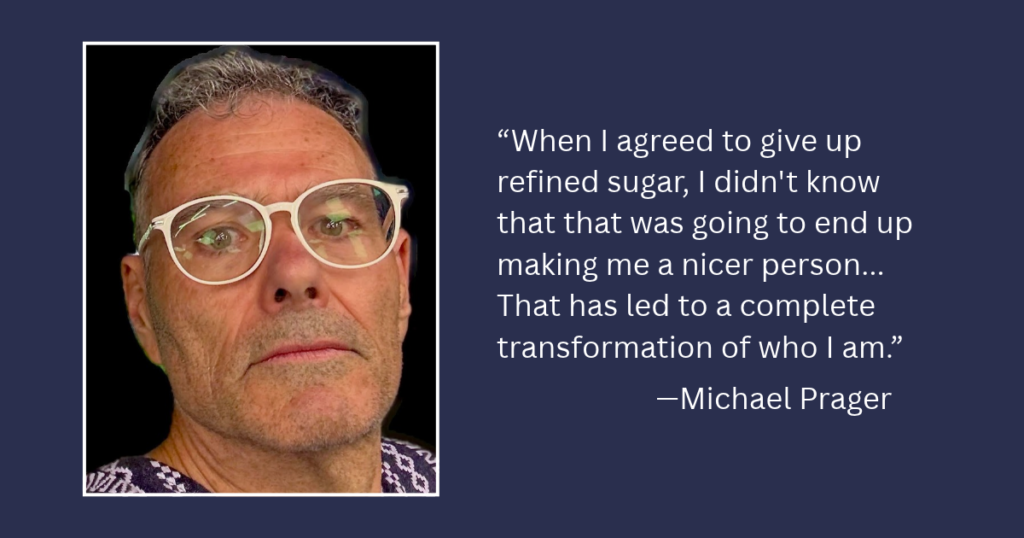
A former newspaper journalist with a 30-year career that included serving as an editor at The Boston Globe, Michael is the author of two books, Fat Boy Thin Man and Sustainable You. He is also a co-founder of the Food Addiction Institute, established in 2005, and currently serves as chair of its board of directors.
On Jan. 29-31, Michael will bring his story and decades of advocacy to the Symposium for Metabolic Health in San Antonio, where a full day of programming will focus on food addiction, its underlying mechanisms and its implications for treatment.
From personal struggle to a lifelong mission
Michael’s experience with carbohydrate restriction began long before low-carb diets became part of the modern metabolic health conversation.
In 1974, while still in high school, he became a patient of Dr. Robert Atkins, whose approach helped him lose substantial weight. But lasting success remained elusive.
By October 1991, Michael was back to 365 pounds. He had already spent several years working with a professional who had encouraged him to attend a 12-step program for food-related struggles. Although initially reluctant, Michael followed that advice, beginning a process of personal change that would eventually lead to a recommendation for residential treatment. He spent nine weeks in rehabilitation in 1991, an experience he now regards as a turning point.
Even then, recovery was neither immediate nor linear. He continued struggling with his weight for years while gradually learning to approach food, relationships and personal responsibility differently.
Michael credits professionals and fellow patients who shared their experiences and demonstrated that another way of living was possible.
“I am the beneficiary. I am not the guy who thought it up, and I’m very grateful,” he said.
That gratitude eventually became a commitment to helping others discover possibilities they may not have considered.
“If I help one person, that’s what I set out to do,” he said.
Among those who profoundly influenced Michael was the late Phil Werdell, a pioneer in food addiction treatment who founded the Food Addiction Institute in 2005. Michael, who was present at the institute’s founding meeting in Sarasota, Florida, credits Werdell with helping advance the recognition and treatment of food addiction at a time when the concept received relatively little attention from mainstream medicine.
Their shared conviction — that people struggling with food addiction deserved access to the knowledge and treatment that had helped others recover — became a driving force behind the organization’s advocacy and educational efforts.
Why food addiction remains controversial
Despite decades of research and growing public interest, food addiction remains a contested subject within medicine.
It is not currently recognized as a distinct clinical diagnosis in the American Psychiatric Association’s Diagnostic and Statistical Manual of Mental Disorders or the World Health Organization’s International Classification of Diseases.
Researchers have, however, developed assessment tools, including the Yale Food Addiction Scale, which applies established substance use disorder criteria to addiction-like eating behaviors. Scientific debate continues over how best to define these behaviors and distinguish them from recognized eating disorders.
Michael believes formal diagnostic recognition could transform how clinicians identify and treat patients who struggle with compulsive eating.
His concern is that many health professionals receive little education about food addiction and may not recognize potentially important patterns in their patients.
“Most doctors don’t ask their patients about food addiction or about their eating patterns,” he said.
For Michael, the distinction between obesity and food addiction is especially important. Although the two may overlap, he emphasizes that they are not interchangeable.
He also challenges the assumption that people struggling with food need only exercise greater willpower or follow a more disciplined diet.
Some individuals, he explained, can consume highly processed foods, occasionally overindulge and return to their usual eating patterns. Others may experience persistent cravings and repeated consumption despite their intention to stop.
Recognizing those differences, he believes, could lead to more individualized and effective approaches to care.
Three perspectives, one important conversation
Michael’s presentation in San Antonio will explore the history of food addiction research and advocacy, tracing developments that began decades before the subject attracted widespread attention.
He will be joined by two fellow Food Addiction Institute board members whose presentations will approach the subject from complementary perspectives.
Susan Peirce Thompson, Ph.D., a cognitive scientist affiliated with the University of Rochester and founder of Bright Line Eating, will examine the neuroscience and biochemistry of food addiction, including the brain’s reward systems and the mechanisms that influence cravings and eating behaviors.
Kim Dennis, M.D., a psychiatrist board-certified in psychiatry and addiction medicine, is co-founder and chief medical officer of SunCloud Health. Drawing on extensive clinical experience treating eating disorders, addiction and co-occurring psychiatric conditions, Dennis will address the practical challenges of treating patients struggling with food addiction.
Together, the three presentations are intended to connect the historical foundations of food addiction research with current scientific understanding and real-world clinical experience.
Michael describes his own role as that of a “table setter,” preparing audiences to consider evidence and perspectives they may not have previously encountered.
He hopes the sessions will encourage even skeptical clinicians to reconsider how they approach patients who struggle with food.
“Maybe I should be asking my patients. Maybe I should look more into it,” he said, describing the response he hopes to inspire.
The possibility of lasting change
For individuals who feel trapped in cycles of cravings, overeating and repeated weight-loss attempts, Michael’s message is grounded in experience rather than promises of a quick solution.
He recalls believing that his own circumstances were permanent.
“I thought I was doomed. I thought that’s just the way it is. I better get used to it,” he said.
His eventual progress began with a willingness to consider advice he initially resisted. One early change involved eliminating refined sugar, although he was not initially prepared to eliminate refined grains.
What mattered was discovering that he could make a meaningful change and build upon it.
“I didn’t die, and it seemed to work out well for me. What else can I try?” he recalled thinking.
That willingness to experiment ultimately reshaped far more than his eating habits. Michael credits the process with changing his relationships, his outlook and his capacity to accept help from others. In a short video excerpt from our conversation, Michael reflects on how changing his relationship with food ultimately transformed his life in ways he never anticipated.
For attendees of the San Antonio symposium, his experience offers a compelling starting point for a larger conversation about food addiction, metabolic health and the possibilities for lasting behavioral change.
The three-day symposium, presented by LowCarbUSA in collaboration with the Society of Metabolic Health Practitioners, will bring together clinicians, researchers, health coaches and individuals interested in therapeutic carbohydrate reduction and metabolic therapies.
Along with the dedicated food addiction programming, attendees will have opportunities to learn from leading experts, exchange experiences and connect with others working to improve metabolic health.
Michael’s story is a reminder that transformation does not always begin with having the right answers. Sometimes it begins with being willing to consider a different question.
The three-day symposium, presented by LowCarbUSA in collaboration with the Society of Metabolic Health Practitioners (The SMHP), will bring together clinicians, researchers, health coaches and individuals interested in therapeutic carbohydrate reduction and metabolic therapies.
Along with the dedicated food addiction programming, attendees will have opportunities to learn from leading experts, exchange experiences and connect with others working to improve metabolic health. The symposium is open to the public, with both in-person and livestream attendance options. The ACCME-accredited event also offers eligible health care professionals the opportunity to earn up to 22 AMA PRA Category 1 Credits™.
Learn more about the Jan. 29-31, 2027, Symposium for Metabolic Health in San Antonio, explore the speaker lineup and register to attend at the official event page.