Dr. Ana Rosa returns to the Symposium for Metabolic Health in San Antonio in January with message about addiction, awareness and connection
There was a moment in Dr. Ana Rosa’s own health journey when she found herself standing in front of the refrigerator.
She stopped and asked herself a simple question: “Am I hungry?”
The answer changed the way she thought about food.
Dr. Ana Rosa, a U.S.- and Brazilian-board-certified radiologist, had spent much of her life cycling between losing and gaining weight. After her husband died in 2016, she reached 226 pounds while using food, she said, to numb grief, fear and other painful emotions.
But standing in front of that refrigerator, she realized the hunger she was experiencing was not necessarily for food.
“I’m hungry for a hug. I’m hungry for connection,” she recalled.
That realization became part of a much larger journey — and it will help shape the conversation when Dr. Ana Rosa returns to the Symposium for Metabolic Health, scheduled for Jan. 29-31, 2027, in San Antonio.
This year, the symposium will devote an entire Special Focus Day to Food Addiction, bringing together clinicians, researchers and people with lived experience to explore one of the most challenging — and sometimes controversial — subjects in metabolic health.
When the Trigger Becomes the Teacher
Dr. Ana Rosa first spoke at a LowCarbUSA symposium in San Diego in August, where she delivered presentations on visceral fat and inflammation and the science of gratitude for metabolic health.
In San Antonio, she expects food addiction to become an important part of her participation.
For Dr. Ana Rosa, the subject is not theoretical.
“Food addiction is real. Food addiction is raw, and it hurts a lot,” she said.
Her own experience has taught her to pay attention to the moment between an uncomfortable emotion and the behavior used to escape it.
Rather than immediately trying to eliminate that discomfort, she encourages people to first recognize it.
“My invitation is that you shift the trigger to your teacher,” she said.
That may mean sitting with an uncomfortable feeling for only a few seconds before choosing what happens next. It may mean breathing, walking outside, calling or texting a friend, taking a shower, drinking water slowly or using movement to interrupt an automatic response.
The goal is not perfection. It is creating enough space to make a conscious choice.
“You are going to be choosing what loves you back, what honors your body, what honors your mind,” she said.
Taking Food Addiction Out of the Shadows
Food addiction remains a subject of disagreement in medicine, nutrition and metabolic health.
Dr. Ana Rosa is well aware of that debate. But when she hears people dismiss food addiction altogether, she thinks about those experiencing behaviors they may be afraid to discuss — eating secretly, continuing far beyond fullness, feeling unable to stop and then experiencing guilt or shame afterward.
For her, arguing over terminology should not prevent those people from receiving help.
“When you shine light, not with judgment, but with acceptance, belonging, and understanding, when you shine light, you give them a chance,” she said. “You give me a chance to come up and say it out loud and ask for help.”
That help, she said, does not always have to begin with another complicated intervention.
It might be someone willing to take a walk with you.
Someone who goes to the grocery store with you.
Someone who helps you prepare food.
Or simply someone who can say, “I see you because I’ve been through that as well.”
Dr. Ana Rosa believes that is one reason bringing food addiction into the open matters.
“It’s not a weight problem, but it’s a mind problem,” she said.
A Conversation Without Shame
That sense of safety and belonging is exactly what Dr. Ana Rosa hopes people will experience in San Antonio.
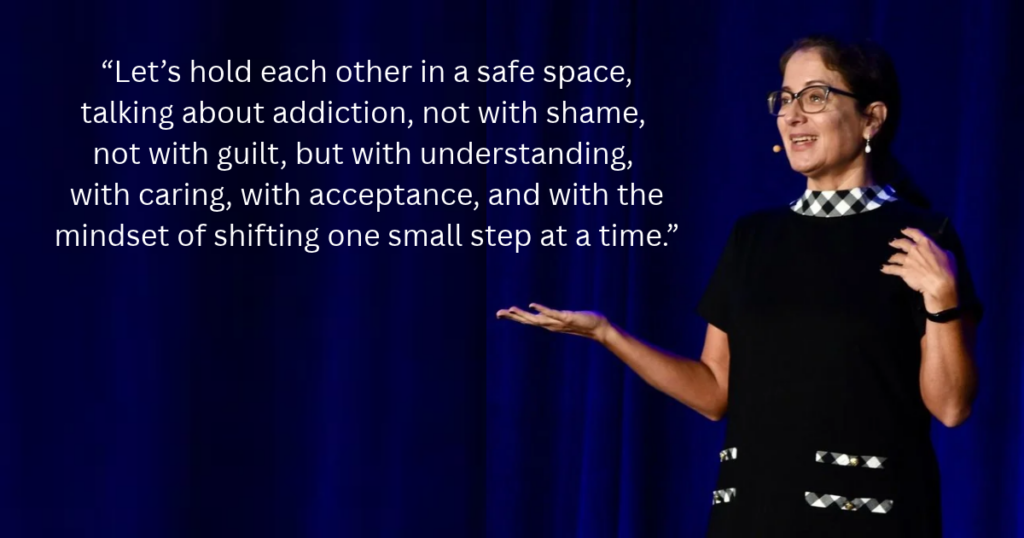
“Let’s hold each other in a safe space, talking about addiction, not with shame, not with guilt, but with understanding, with caring, with acceptance, and with the mindset of shifting one small step at a time,” she said.
Her message also extends beyond food.
Dr. Ana Rosa said her own experience has caused her to examine other behaviors that may serve a similar purpose — including her tendency to overwork. She encourages people struggling with addiction to take what she calls a “bird’s-eye view” of their lives and consider whether other behaviors are also being used to avoid or numb difficult emotions.
Ultimately, she believes recovery is about much more than stopping a particular behavior.
It is about reclaiming the life on the other side of it.
“Take the courage to start saying yes to your life, the life that you are here to live,” she said.
More Than a Medical Conference
Dr. Ana Rosa’s enthusiasm for returning to the symposium also comes from what she experienced in San Diego.
She arrived at her first LowCarbUSA conference as a speaker. She left feeling that she had found a community.
She described an environment where physicians, researchers, coaches, patients and others interested in metabolic health could exchange ideas while also building friendships and connections.
And she believes that matters to health.
“It’s not only about the knowledge, the medical knowledge, the technical knowledge,” she said. “But it’s about family, belonging, connection.”
That may be particularly relevant during a conference that asks people to speak openly about addiction.
Knowledge matters. Science matters. Treatment strategies matter.
But so can knowing you are not the only person in the room who has struggled.
“LowCarbUSA is the tribe,” Dr. Ana Rosa said, “and I am inviting you to come with us.”
Speaking Louder for Metabolic Health
For Dr. Ana Rosa, the value of the symposium also extends beyond what happens during a few days together in San Antonio.
She sees LowCarbUSA and the Society of Metabolic Health Practitioners as platforms that can help clinicians, coaches and others continue challenging conventional approaches to chronic disease and advocating for metabolic health.
“LowCarbUSA is a conference that brings knowledge about metabolic health,” she said. “What is metabolic health? Metabolic health is allowing your body to heal from the inside out.”
Dr. Ana Rosa has completed the required coursework as she works toward becoming a Metabolic Health Practitioner through The SMHP. She believes organizations willing to educate practitioners and publicly advocate for better metabolic health can help move the conversation beyond simply managing disease.
“It is very important to use the platform of LowCarbUSA and theSociety of Metabolic Health Practitioners, to keep speaking louder and louder,” she said.
That means, she said, “advocating for health, advocating for proper food, advocating for less medication, advocating for less processed foods, less drugs, and less alcohol and less addiction.”
Her invitation is not limited to physicians.
“If you are a physician or a healthcare provider or a coach,” she said, “I would invite you to join. I would invite you to come to the conferences. I would invite you to keep learning, and more than that, keep speaking louder and louder for everybody to listen to change what is around us, walking your talk.”
Join the Conversation in San Antonio
The 2027 Symposium for Metabolic Health will take place Jan. 29-31 at the Plaza Hotel in San Antonio. The three-day event is an event of the Society of Metabolic Health Practitioners hosted by LowCarbUSA and can be attended in person or by livestream.
A full Special Focus Day will examine food addiction, with sessions exploring emerging research, clinical strategies and real-world approaches to the problem.
The broader symposium will cover metabolic syndrome and chronic disease, obesity treatment, fatty liver, neurological and mental health applications of metabolic therapy, women’s health, longevity and healthspan, exercise, behavior change, gut health, therapeutic low-carbohydrate and ketogenic nutrition, and other areas of metabolic health.
Attendees can earn up to 22 AMA PRA Category 1 Credits™. For Dr. Ana Rosa, however, perhaps the most important reason to attend is harder to quantify.
It is the opportunity to learn alongside people willing to talk openly about difficult subjects — including the ones that have too often been accompanied by secrecy, guilt and shame.
And, sometimes, to discover that what feels like hunger may actually be a hunger for something else entirely.