
Built around a 1,000-mile cycling journey, Shifting Gears tells a larger story about insulin, freedom, and the pursuit of better-than-average outcomes
For years, Dr. Ian Lake managed his type 1 diabetes the way he had been trained to manage his patients: count the carbohydrates, match the insulin and focus relentlessly on blood sugar. It worked well enough to satisfy conventional standards. It did not work well enough to satisfy him.
Dr. Lake, a UK physician who has lived with type 1 diabetes for more than three decades, was one of the notable voices when LowCarbUSA focused on type 1 diabetes at its 2024 Symposium for Metabolic Health in Boca Raton (LowCarbUSA Type 1 Diabetes Playlist available here). He stood out not simply because he is a doctor, but because he has lived the daily calculations, frustrations and risks of type 1 diabetes himself.
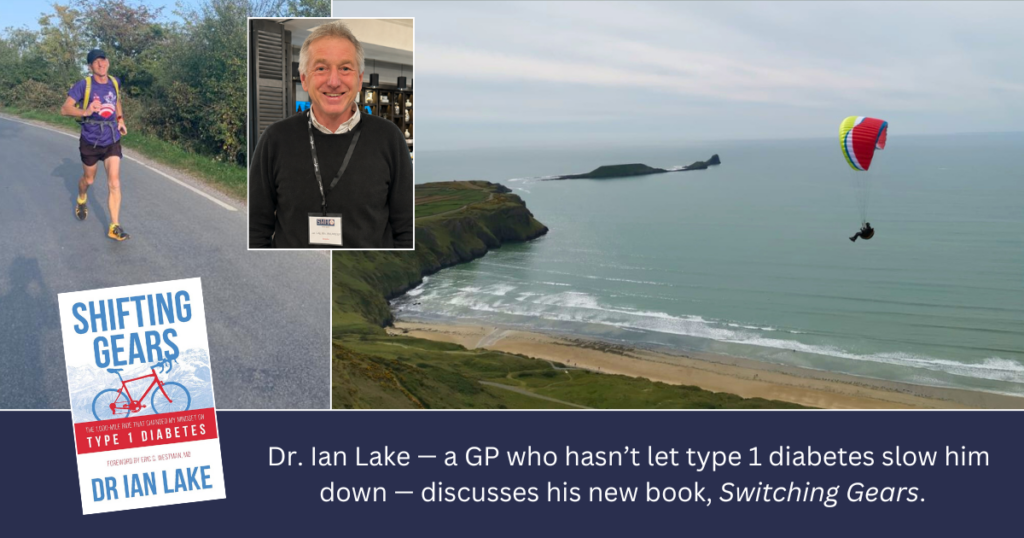
“Now, with his new book Shifting Gears — built around the 1,000-mile cycling journey he used to document his glucose, ketones, insulin decisions and physical performance — Dr. Lake has another way to share what he has learned. But the more compelling story goes well beyond the book. It is the case he has been building for years: that many people with type 1 diabetes are still being taught to manage glucose without giving enough attention to insulin itself — and are often left with a standard of care that may be accepted as normal, but falls well short of what is possible.”
Dr. Lake was diagnosed with type 1 diabetes at age 35. He was already a doctor, and for years he treated himself as he had been taught to treat his patients. He followed carbohydrate counting, used insulin to match, tried the low-fat, high-carbohydrate approach and focused on keeping his blood sugar as flat and low as he could. “I had no regard for the amount of insulin I was taking,” Dr. Lake said. “My only interest was in keeping my blood glucose as flat as I could and as low as I could.”
For a long time, that seemed to be the best anyone could reasonably hope for. Then his control began to deteriorate. His HbA1c rose into the 8% to 9% range. He began dealing with joint pain, autonomic neuropathy and more frequent episodes of hypoglycemia. He also received his first retinopathy letter. It was, in his telling, the kind of warning that can no longer be pushed aside.
The real turning point came during a cycling trip around the North Sea in his mid-50s. Dr. Lake woke alone in Norway with a severe hypo, used all the glucose tablets he had and still could not raise his blood sugar. He eventually made it to a road, where he found discarded bread along the roadside and ate it. That moment shook him.
Soon afterward, he revisited the work of Dr. Richard Bernstein, the pioneering physician with type 1 diabetes whose low-carbohydrate approach has influenced many people looking for tighter control. Dr. Lake sharply reduced carbohydrate intake and saw something he had not seen in a long time: a flat glucose trace. “That completely was such a relief,” he said, “to know that it wasn’t just me that was useless at controlling my diabetes.”
He says the real issue is not just glucose, but insulin
Dr. Lake’s central argument is not that blood glucose does not matter. It is that the conversation around type 1 diabetes has become too narrow.
“We’re looking at the wrong target,” he said. “We’re striving to control the wrong thing.” Later, he put it even more bluntly: “Glucose is a symptom of type one diabetes. It isn’t the cause of type one diabetes. The cause is insulin.”
That is a striking claim, especially coming from a doctor who spent years chasing tight glucose control the conventional way. But Dr. Lake is not arguing against insulin. He is arguing for thinking much more carefully about how much is being used, when it is being used and what happens when patients are asked to manage large amounts of carbohydrate with large amounts of injected insulin. In his view, that dynamic creates volatility that is often treated as normal simply because it is familiar.
He returns again and again to one phrase: “as much as needed, as little as possible.” It is both a practical principle and a philosophical one. The goal is not to avoid insulin. The goal is to optimize it, to reduce unnecessary exposure, reduce the risk of hypos and create conditions that make everyday life more stable and less punishing.
Dr. Lake explained the physiology in straightforward terms. Carbohydrates raise blood glucose the most. More carbohydrates generally require more insulin. More insulin on board, in turn, increases the risk of hypoglycemia, especially when exercise enters the picture and insulin sensitivity changes. “The more insulin on board, the more risk you are at hypo,” he said. “The less insulin, the less you are at risk.” He cited Richard Bernstein’s “law of small numbers” as a principle that shaped his thinking: small amounts of insulin lead to smaller errors and greater safety.
Why so many clinicians resist the conversation
Dr. Lake does not describe mainstream clinicians as uncaring. Quite the opposite. “I’m sure most clinicians are well meaning,” he said. But he also described a medical culture that strongly rewards standardization and punishes deviation. “We are required to conform in order to perform,” he said.
That tension, he suggested, is especially strong in type 1 diabetes. Doctors are trained within a specific framework. They are measured against guideline-driven care. They face professional and legal risk if they move outside what has official approval. In that environment, a patient who wants to pursue a lower-carbohydrate approach can easily be seen not as a motivated outlier, but as a problem to manage. And a clinician who encourages that patient may feel just as exposed.
“When the ‘keto’ word is mentioned in any conversation with diabetes, it tends to freeze the room and the temperature drops and conversation changes,” Lake said. He described years of trying to share what he had learned with colleagues, only to find that many were not ready to hear it. “I’ve been trying for 10 years, trying to appeal to my colleagues, and they’re not really ready to listen right now.”
He thinks that leaves many patients stranded in a familiar kind of uncertainty. They may suspect there is a better way to manage their condition, but if their doctor tells them the alternative is risky, unsound or unsustainable, many will not feel confident enough to begin. “The majority of people that I see don’t have that confidence to move forward because their doctors are telling them exactly the opposite of what they think they should be doing,” he said.
Zero Five 100 was one attempt to prove what he believed
Before the 1,000-mile ride that became the backbone of Shifting Gears, Dr. Lake had already gone looking for a way to demonstrate that his ideas about type 1 diabetes, insulin and ketosis could hold up under stress.
Zero Five 100 was one of his first serious attempts to do that. Dr. Lake came up with the project after growing frustrated that simply providing information was not enough to persuade skeptical colleagues. The concept was intentionally bold: cover 100 miles on foot in five days on water and salt alone, pushing participants into deep ketosis and documenting what happened.
Dr. Lake wanted to challenge several recurring assumptions at once: that nutritional ketosis in type 1 diabetes was inherently unsafe, that sport required carbohydrates and that people with type 1 diabetes could not function well in that metabolic state. The results were striking. The participants completed the challenge, the two people with type 1 diabetes had no incidents, blood glucose remained stable and the ketone readings of the type 1 participants could not be distinguished from those without type 1 diabetes when the group data were aggregated.
For Dr. Lake, that was not the end of the story. It was the launching pad.
The 1,000-mile ride became a way to show what freedom can look like
When Dr. Lake later had the opportunity to travel to Switzerland to speak about sport in type 1 diabetes, he decided to cycle there. What began as a practical idea soon became something more ambitious. He would document continuous glucose data, ketones, heart rate, insulin use, food and distance. There would be, as he put it, “nowhere to hide my blood sugars.”
The resulting journey gave him the structure for Shifting Gears, but more important, it gave him a narrative demonstration of the life he is trying to describe. “If you want to understand someone with type one diabetes, try cycling in my shoes for 21 days,” he said.
At one point on the ride, he realized he had eaten, taken the required insulin, and could “forget my diabetes for the rest of the day” even though he was about to cycle 41 miles. On the final day, after climbing a Swiss mountain pass, he arrived and was asked how his blood sugar had been. “I said, I do not know, because I haven’t checked it,” he recalled. “And that was the honest truth.” His glucose, he later found, was normal.
That, more than any single performance metric, may be the heart of Dr. Lake’s story. He is not trying to prove that type 1 diabetes disappears. He is trying to show that it can recede enough that it no longer occupies the center of every hour.
Still, the metrics were impressive. Over the 21 days, he said his average glucose was 6.2 mmol/L, or about 111 mg/dL, and he spent 89% of the time in range. He used only two glucose packs across the entire trip, despite carrying enough to use one each day. He also said his insulin use compared favorably with published data involving Team Novo Nordisk cyclists, whose time in range was lower and daily insulin use higher.
Dr. Lake is careful not to imply the ride was effortless. On the first day he badly overcorrected and put himself into a significant hypo. Rain complicated the trip. He adjusted meal timing, shifted from two meals to three and relied more heavily on long-acting insulin than rapid-acting insulin because of how exercise changed his insulin sensitivity. “It wasn’t as easy to achieve as it sounds,” he said. “There’s lots of calculations, lots of maneuvering.”
That admission makes his story more believable, not less. He is not marketing a miracle. He is documenting a method.
The book matters, but the deeper message goes beyond the book
Dr. Lake said he wrote Shifting Gears as part travel journal and part accessible science book. One half tells the story of the ride and his decision-making along the way. The other half explains the physiology and biochemistry of type 1 diabetes, along with what he calls the five foundations of health: sleep and circadian rhythm, physical activity, diet, mindset and the lived environment.
That last part is important. Dr. Lake does not reduce type 1 diabetes to food alone. He repeatedly emphasized that glucose control changes with stress, with time of day, with movement, with outdoor exposure and with the background state of the body. “It’s not just food that affects type 1 diabetes,” he said. The wider goal, in his telling, is to understand how insulin interacts across all of those foundations.
He also made clear that he wrote the book primarily for people with type 1 diabetes, not for fellow physicians. He wants readers to understand the science well enough to have an informed conversation with their clinicians and to recognize that there may be more than one path available to them. “The whole basis of the book,” he said, “is condensing all of my knowledge into a medical textbook as well as a story.”
For parents, patients and clinicians willing to think more deeply, that may be the book’s most valuable contribution. It is not merely saying that Dr. Lake did something unusual. It is trying to explain why he believes the result was possible in the first place.
The most powerful line in the interview may also be the simplest
Late in the conversation, Dr. Lake arrived at a distinction that seemed to capture his whole project.
“I can be someone who is exercising and has type one diabetes,” he said, “not someone who has type one diabetes who is exercising.”
That is not a throwaway line. It is the difference between a life organized around disease and a life in which disease, while still real, is no longer the dominant fact. It is the difference between coping and participating. Between managing decline and reclaiming agency.
Dr. Lake is 67 now. He still practices medicine part time. He is still active outdoors. He still does coaching through his Type 1 Keto website. He still hears from people who are informed enough to be curious, but not yet confident enough to act. Many, he said, need not so much a new theory as the reassurance that they are not reckless for wanting better than average outcomes.
That may be the most compelling angle in this story, and the one most worth carrying forward from Boca to a wider audience. Dr. Lake is not simply promoting a book. He is challenging the assumption that people with type 1 diabetes should be satisfied with management that is merely acceptable. He is asking whether medicine has become too comfortable aiming for the middle — and what might happen if more patients, and more clinicians, started aiming higher.
For readers interested in learning more about metabolic health, therapeutic carbohydrate reduction and other emerging approaches to care, LowCarbUSA’s upcoming Symposiums offer a valuable opportunity to hear from leading clinicians, researchers and educators. You can learn more on the LowCarbUSA website about the 11th Annual San Diego Symposium for Metabolic Health, Aug. 13–16, 2026, the 2027 San Antonio Symposium for Metabolic Health, Jan.29-31, 2027, and the 2028 Boca Raton Symposium for Metabolic Health, Jan. 29–31, 2027.