Presentation tackled a question driving debate in cardiology: What does high LDL mean in a metabolically healthy person?
BOCA RATON, Fla. — One of the most engaging themes at the 2026 Boca Symposium for Metabolic Health focused on a topic that continues to spark debate in medicine: the role of LDL in cardiovascular disease, especially in people who have improved their metabolic health on a low-carbohydrate diet.
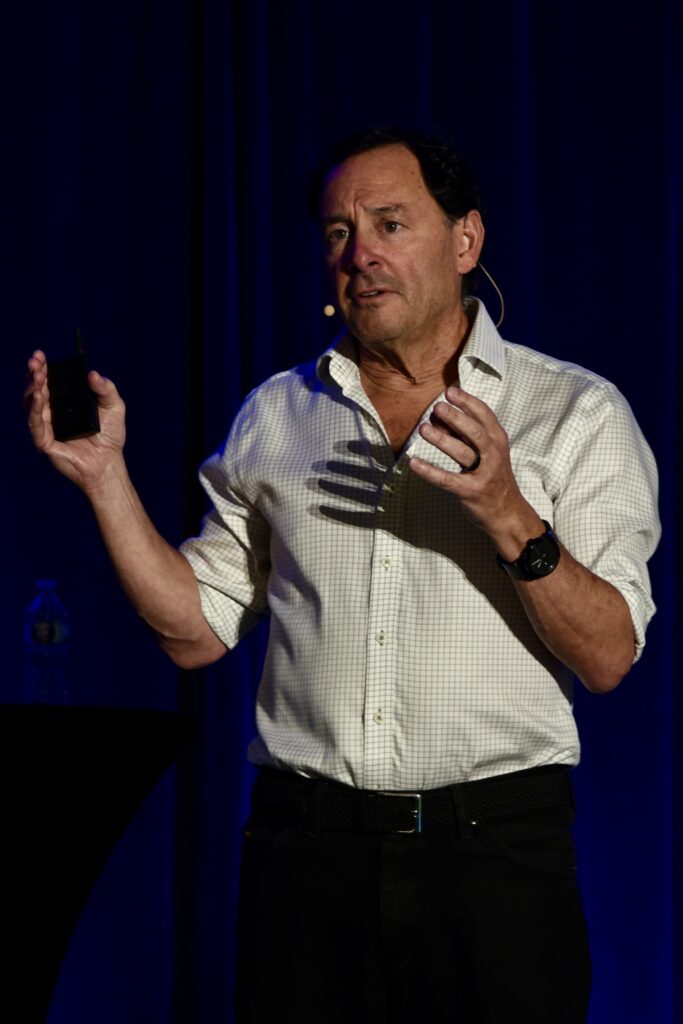
That conversation took center stage during the Symposium’s cardiovascular-focused programming, where researchers, clinicians, practitioners and an engineer came together to examine heart disease risk from multiple angles. Among the featured speakers was David Diamond, PhD, whose presentation challenged some of the most deeply ingrained assumptions in lipidology and preventive cardiology.
Diamond opened with a nod to the evolution of his own thinking. “For those of you who know my story and see my presentations, you’ll see that my title is a departure from my prior views, in which I’m actually going to be talking about LDL being involved in causing cardiovascular disease,” he said. “But as I learned, the story changes, so you’ll get that modified story today.”
A personal story behind a public controversy
Diamond explained that his interest in the topic was not merely academic. Decades ago, he said, he was diagnosed with what he described as “a rather lethal form of hypercholesterolemia,” with extremely high triglycerides, low HDL and very high LDL. After reducing carbohydrates, he said he lowered his triglycerides and raised his HDL, improving his metabolic health substantially.
But one issue remained.
“I was faced with a problem that I still had high LDL,” Diamond said.
That, he argued, is the same dilemma many people in the low-carb community face after reversing markers of metabolic dysfunction. “So this person has now gone on a low carb diet, becomes metabolically healthy, they feel great, reverse hypertension, diabetes, off all their meds, but now you have high LDL-C, which now puts you at risk of developing a heart attack.”
For Diamond, that framing has never been satisfying. “That’s the issue that I’ve been faced with for the last 26 years, because I still have LDL, high LDL, which I have not used any medication to lower.”
Looking beyond LDL-C alone
A major theme of Diamond’s talk was that LDL-C, by itself, does not adequately describe cardiovascular risk. He repeatedly contrasted total LDL-C with other markers he believes are more meaningful, including triglyceride-to-HDL ratio, fasting glucose, coronary calcium and LDL particle characteristics.
“I’ve covered how LDL-C is a useless marker, a useless predictor of cardiovascular disease, because it’s a mixture of the small, dense and the large buoyant LDL,” he said later in the presentation.
Diamond argued that the quality of the particles matters more than the total cholesterol carried within them. In his telling, a low-carb diet may raise LDL-C in some people while simultaneously improving metabolic health and shifting the balance toward what he called “large, buoyant LDL.
“If low carb increases LDL-C, it is only because it has increased your production of the large buoyant LDL,” he said.
If there was one measure Diamond returned to again and again, it was coronary artery calcium.
“So the coronary calcium trumps the LDL, and it’s completely independent of LDL,” he said.
By contrast, he associated “small, dense LDL” with metabolic dysfunction, high triglycerides, low HDL, elevated blood sugar and increased cardiovascular risk. “So therefore, it doesn’t matter how high your LDL-C is,” Diamond said. “What really matters is the quality of the particle. If you’ve got a dominance of small, dense LDL, that’s a sign of an unhealthy metabolism.”
Familial hypercholesterolemia, longevity and the challenge to conventional thinking
One of the most striking aspects of Diamond’s presentation was his use of familial hypercholesterolemia, or FH, to question the idea that high LDL alone necessarily drives poor outcomes.
Reviewing published research, he pointed to reports suggesting that some people with FH have lived to old age, and in some cases showed normal lifespan patterns. He also cited data he said showed no increased stroke risk in FH populations and lower all-cause mortality in some older groups.
“At about the age 60, those people with extremely high uncorrected LDL are dying at a lower rate compared to those of the same age in Norway,” Diamond said. Referring to one subgroup in their 70s, he added that there was “a 40% lower rate of death,” which he described as “completely inconsistent with what you’re taught in medical school.”
He took the point even further when discussing cause-specific mortality. “They are not dying at a higher rate from cardiovascular disease,” he said. “Not only is the hypothesis not supported that these people are less healthy and they’ll have an early demise, these people are damn healthy.”
Whether one agrees with Diamond’s interpretation or not, his presentation captured exactly why the Symposium’s cardiovascular track was so valuable. Rather than reducing the conversation to a slogan, it In reviewing studies of people with FH, Diamond emphasized that coronary events were associated not with LDL levels alone, but with the presence of coronary calcium and with markers of metabolic dysfunction, including fasting glucose. “The coronary calcium does associate with insulin resistance, high fasting glucose, coronary calcium, cardiovascular disease, independent of LDL levels,” he said.
He also drew attention to triglyceride-to-HDL ratio, arguing that it provides more insight than LDL-C in both lower- and higher-LDL groups. “The LDL-C is irrelevant,” he said while discussing one study. “The people who have extremely high LDL … have the same low incidence of coronary events when they’ve got the good ratio.”
That message resonated strongly with the broader theme of the Boca Symposium: that cardiovascular risk cannot be meaningfully understood in isolation from metabolic health.
Statins, relative risk and the numbers patients rarely hear
Diamond also devoted a significant portion of his presentation to statins, focusing especially on how trial results are communicated to patients.
Using the JUPITER trial as an example, he challenged the way relative risk reduction figures are often presented. Referring to Crestor’s widely cited reduction in heart attack risk, he said, “I’m going to show you the raw data. This is what I’m famous for. I show you the actual data.”
Diamond contrasted the headline claim of a 54% reduction in myocardial infarction with the absolute event rates in the study. “Over 99% of the people in this trial did not have a heart attack,” he said. “And yet the difference between the red bar and the blue bar is 54%.”
Then came one of the presentation’s most memorable lines: “Do you feel deceived? This is what we’re talking about, relative risk. With relative risk, you are taking a difference between percentages, you are then amplifying it to make it appear as if you’ve got this huge effect.”
He summarized the practical implication this way: “The number needed to treat is 220. What this means is 220 people need to take Crestor for years for one person to have one less heart attack.”
Diamond did acknowledge that statins may have some benefit, but he argued that those effects are modest and likely driven by mechanisms beyond LDL lowering alone. He also emphasized potential adverse effects, including cognitive concerns. “If I take a medication and I’ve got forgetfulness as a result of the medication, I don’t think of that as non-serious,” he said. “I think it’s pretty serious.”
The glycocalyx, small dense LDL and a broader model of heart disease
In the final section of his talk, Diamond shifted from epidemiology and outcomes to mechanism, arguing that the endothelial glycocalyx deserves far more attention in discussions of atherosclerosis.
He described the glycocalyx as a protective, gel-like layer lining the inside of arteries and veins and called it “a barrier between health and disease.” In a metabolically healthy environment, he said, this system remains intact. In a metabolically unhealthy one — with high glucose, insulin, triglycerides, blood pressure and small dense LDL — it can be damaged or “shed,” creating conditions for clotting, inflammation and plaque development.
“The small dense LDL is nonfunctional,” Diamond said. “It shouldn’t even be called LDL.”
That line captured the broader point of the presentation: that lumping all LDL-related measures together may obscure meaningful differences between particle types, metabolic contexts and actual drivers of disease.
Why talks like this matter at a Symposium like Boca
Diamond’s presentation did not merely revisit a familiar low-carb talking point. It modeled something the Symposium has become known for: bringing together serious thinkers who are willing to challenge assumptions, examine the literature and follow the evidence where it leads.
That was especially important in Boca, where a day and a half of programming was dedicated to cardiovascular conditions. The result was not a simplistic anti-mainstream message, but a deeper and more nuanced conversation about risk, prevention and the limits of one-size-fits-all medicine.
For attendees, presentations like Diamond’s offer more than controversy. They offer context. They offer questions worth asking. And they reinforce why the Symposium for Metabolic Health remains such a valuable gathering place for clinicians, researchers, health professionals and members of the public who want to better understand the science behind metabolic health.
As Diamond put it near the end of his talk, “There is no scientific justification for a metabolically healthy person with high LDL-C to take lipid-lowering medication.”
That is a provocative statement. It is also exactly the kind of statement that benefits from being heard, examined and debated in a room full of experts.
The Boca Symposium delivered that opportunity, and the conversation is far from over.
With the 11th Annual San Diego Symposium for Metabolic Health coming in August 2026, followed by the San Antonio Symposium for Metabolic Health in January 2027, LowCarbUSA® will continue creating space for these important discussions — bringing together the clinicians, scientists and leaders willing to tackle the toughest questions in metabolic health.
All of the presentations from the 2026 Boca Symposium are available here.