Why “Doing Everything Right” Still Fails for Some People
Craig Emmerich did not come into the nutrition world as a conventional health personality. He came through engineering, health care software, years of self-education in biochemistry and nutrition, and a long stretch of personal health struggle that pushed him to think about metabolism less as an ideology and more as a system.
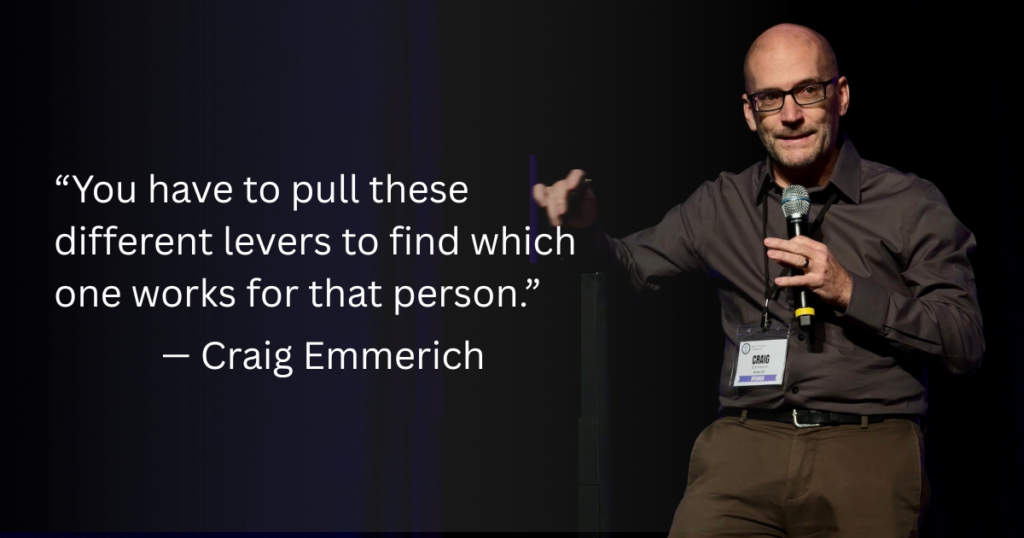
Before entering the nutrition field, he trained as an electrical engineer and spent nearly a decade in product management for health care software systems.
He later brought that systems-based mindset into the work he built with his wife, Maria Emmerich—working directly with clients to help them improve their health, lose weight and better understand how to work with their biology rather than against it.
Over the past 15-plus years, Craig and Maria have worked with thousands of individuals navigating metabolic dysfunction, weight loss resistance and chronic health issues.
Their approach has also reached a broader audience through books, programs and speaking engagements, including the 2025 San Diego Symposium for Metabolic Health, where Craig presented a talk entitled “A Deeper Dive Into Insulin and Ketones.”
Craig’s perspective was shaped not just by research, but by experience.
He spent more than a decade dealing with Lyme disease, chronic inflammatory response syndrome, mold exposure, heavy metal issues and chronic pain—an experience that forced him to look beyond simple dietary answers and into the deeper drivers of inflammation, recovery and metabolic health.
That combination of personal experience and years of hands-on client work shows up clearly in the ideas Craig and Maria share today.
Their recent book, The Art of Metabolic Health: A Science Based Guide to Fat Loss, Hormone Health and Metabolic Resilience., reflects those insights—but the thinking behind it was built long before it was written.
For people who spend time in the low-carb and carnivore world, the arguments can start to sound familiar. Eat more fat. Stop counting. Chase ketones. Trust satiety. Don’t overthink it.
Craig does not reject those approaches. But he and Maria have seen too many different outcomes to believe those ideas work the same way for everyone.
“It’s a spectrum of things that you can do, and it’s very individual,” he said, adding that people come into this space with “very different situations” that require “different approaches and protocols.”
Why one-size-fits-all advice breaks down
That view was shaped in part by his own experience. Craig said strict carnivore helped control pain and inflammation during some of his worst years with Lyme disease, but it did not eliminate the deeper problem.
“I ate strict carnivore for six, seven years,” he said, “but it was to kind of control the pain, but I knew that I had to do other modalities and other things to address the root cause, because nothing I eat is going to kill the Lyme.”
Food, he said, can be central—but not every problem is food-originated. “You still got to address the root causes. And if the root cause is not food, then you got to look at other modalities.”
That perspective shows up repeatedly in their work with clients. Many people who feel stuck are not lacking discipline. They are working from an incomplete model.
Craig and Maria often see progress limited by factors that go beyond food alone: poor sleep, chronic stress, low daily movement, hormonal shifts, alcohol intake, environmental exposures and other physiological stressors.
The issue, in many cases, is not effort. It is context.
The body is not a calorie bank
One of the core ideas Craig returns to is that the body does not behave like a simple calorie bank.
It does not treat all incoming energy the same way. Instead, it prioritizes fuels. Some are burned first. Some are stored more easily. Some interfere with access to others.
That perspective helps explain why two people can follow similar diets and see very different outcomes—and why someone can be doing everything “right” and still not be getting results.
Craig described insulin in a way that cuts through much of the confusion: not as a simplistic villain, but as “a traffic cop” directing fuels based on what is in the bloodstream and what needs to be processed first.
In that context, the question is not just how much someone is eating, but what signals the body is responding to—and how those signals affect storage, access to energy and metabolic flexibility.
Why ketosis is not the same as fat loss
That distinction becomes especially important when the conversation turns to ketosis.
“One thing about high blood ketone levels is that you get a lot of benefits from it,” Craig said, “but there is not necessarily a correlation between high blood ketone levels and fat loss.”
He said he and Maria have seen both ends of that spectrum: people with relatively low ketones losing body fat, and people with high ketones gaining weight.
The difference often comes down to what the body is actually doing with incoming fuel.
A person can be eating low-carb or carnivore, avoiding sugar, and producing ketones—but still not be in a state where stored body fat is being reduced.
Why generic high-fat advice can backfire
That dynamic becomes more visible when looking at common advice in the carnivore and low-carb space.
“One of the things that happens in this community that gets a little bit discounted sometimes,” Craig said, “is that somebody who’s obese, coming into carnivore or whatever it might be, the fact that they’re obese likely means they’re leptin resistant as well.”
In that state, satiety signaling may not work as expected. Which means that advice like eating “the fattiest cuts until you’re full” can lead to unintended outcomes.
Craig said he and Maria regularly hear from people who started gaining weight after following that version of carnivore guidance. “We get it almost daily, weekly for sure,” he said, and “almost always it’s post menopausal women.”
That pattern connects closely to what they see with hormonal shifts, particularly during menopause, where changes in estrogen, insulin sensitivity and recovery can alter how the body responds to both carbohydrates and fat intake.
Why macros still matter
One reason Craig emphasizes precision is because vague advice often hides important differences.
“That’s why we focus so much on macros,” he said.
Percentages, he explained, can be misleading. A person eating 20 percent protein on 5,000 calories is in a very different position than someone eating 20 percent protein on 1,000 calories.
The more useful question is how many grams of protein, fat and carbohydrate someone is actually consuming.
“You really have to quantify things,” he said, “in order to understand where they’re at and what to adjust, which lever to pull.”
That same thinking shapes his view on tracking. “I can’t adjust what I don’t know,” he said.
For Craig, tracking is not a long-term requirement. It is a diagnostic tool—a way to see clearly what is happening when progress stalls.
Why some people are not failing but misreading the problem
Another pattern Craig sees frequently is that people misinterpret what is happening when results slow down.
Sleep is one of the most overlooked factors.
He described conversations with people who say they feel constantly hungry despite eating low-carb—only to reveal they are sleeping five or six hours per night and considering that “good.”
“This is why you’re so hungry,” he said.
Along with sleep, Craig pointed to alcohol, gut health, inactivity and chronic stress as factors that can quietly undermine progress.
In those situations, pushing harder on diet alone often does not solve the problem. It can make it worse.
The better approach is to step back and reassess what the body is responding to.
Why their latest book feels broader than a diet argument
That broader perspective is what makes Craig and Maria’s work feel different from a typical nutrition argument.
Their focus is not just on what to eat, but on how metabolism connects to real-world conditions—Crohn’s and colitis, hypertension, thyroid issues, acid reflux, menopause, dementia, metabolic syndrome, Lyme and more.
Readers will debate some of the specifics. But the larger value is easier to see: they are trying to connect metabolic health to the problems people are actually trying to solve.
Low-carb and ketogenic approaches remain among the most powerful tools available for improving metabolic health.
Craig and Maria’s contribution is to extend that conversation—especially when someone stalls, struggles or runs into a problem the standard playbook does not explain.
Craig said that perspective comes from years of working with people whose situations rarely fit one simple template. “It’s very different situations that people come into it that require different approaches and protocols,” he said.
That does not weaken the case for low-carb. It strengthens it.
The goal is not to apply those tools more rigidly. It is to apply them more precisely—and in a way that accounts for the individual.
As Craig put it, “The restriction doesn’t need to be the end goal.”
Where conversations like this continue
Conversations like this one are part of a broader shift happening in metabolic health—away from one-size-fits-all advice and toward more individualized, physiology-driven care.
The 11th Annual San Diego Symposium for Metabolic Health, in collaboration with the Society for Metabolic Health Practitioners, returning to the Wyndham San Diego Bayside Hotel August 13-16, 2026, brings together clinicians, researchers, patients and health-focused individuals to explore evidence-based approaches to metabolic health and chronic disease.
Sessions examine the metabolic drivers of conditions such as diabetes, obesity, cardiovascular disease, and neurological and mental health disorders, with a particular focus on underlying factors like insulin resistance and inflammation.
This year’s program also includes a dedicated focus day on the metabolic roots of obesity and type 2 diabetes.
The sessions will explore key drivers such as insulin resistance, hormonal regulation, inflammation and energy balance, along with a closer look at GLP-1–based therapies—how they work, why some individuals experience limited or short-term results, and how they may fit into a more comprehensive metabolic health strategy.
Both in-person and livestream options are available, along with up to 28 AMA PRA Category 1 Credits™ for health professionals, and metabolic health practitioners.