
The Medifoodz founder says the company is trying to make ketogenic nutrition easier for patients — and easier for clinicians to monitor
For years, the low-carbohydrate community has made the case that nutrition can play a powerful role in metabolic health.
But even when patients understand the science, another problem often remains.
What do they actually eat tomorrow?
Brian Ruby, founder of Medifoodz Inc., believes that question is where many patients struggle. Not because they do not care. Not because they have not heard the message. But because the daily work of following a ketogenic diet can quickly become complicated.
“There’s growing recognition of the science and that it works, but with that also comes a recognition that people have real trouble with compliance over any length of time,” Ruby said.
Ruby’s company has developed Glyvance, a door-delivered ketogenic nutrition program that combines prepared meals, continuous glucose monitoring, app-based support and a clinician-facing portal.

Glyvance is also a sponsor of the 2026 Symposium for Metabolic Health in San Diego, where Dr. Adrian Soto-Mota is scheduled to discuss related preliminary research comparing a ketogenic meal program with meals based on American Diabetes Association recommendations.
For Ruby, though, the larger issue is not whether carbohydrate restriction has promise. It is whether the field can make it practical for more people.
“We give somebody who wants to use nutrition in their practice a way to go after that,” Ruby said.
The gap between advice and execution
Ruby said much of the current nutrition landscape is built around advice.
Patients can buy books, subscribe to apps, work with coaches, meet with dietitians or receive guidance from physicians. Those tools can be valuable. But they still leave the hardest part to the patient: planning, shopping, cooking, tracking, adjusting and repeating the process every day.
“You’re buying advice: the cookbook, the Diet Doctor subscription, the health coach, the nutritionist, the functional medicine doctor,” Ruby said. “They can’t do the thing for you. They can tell you how to do the thing, and that makes you do all the work.”
Glyvance is designed around a different idea: Remove as much friction as possible.
The program provides frozen ketogenic meals delivered to the patient’s home, along with electrolytes, craving-focused snacks, CGM integration and digital tools intended to help patients stay within the structure of the program.
“We are doing the work for the patient and putting the lifestyle in a box,” Ruby said.
He compares it to a homeowner who wants to build an addition. A person could buy books, watch videos, purchase tools and pick up materials at the store. Some people can do that successfully. Most cannot.
“There are books they can buy that will tell them how to do it,” Ruby said. “That big orange store sells everything they need, every tool, every piece of material they need to do a beautiful extension on their house. Good luck.”
A clinical product built around food
Ruby describes Glyvance as a clinical nutrition platform — one that starts with food but also includes monitoring, feedback and clinician visibility.
Ruby said the company is trying to bring a more rigorous, clinical mindset to a space where many products are marketed primarily around convenience, weight loss or lifestyle.
“We’re trying to build a clinical product here,” he said. “It’s one of any number of tools that one of these practitioners can use for their patients.”
The preliminary study Soto-Mota is expected to discuss in San Diego is currently available as a preprint, meaning it has not yet undergone peer review. The study compared a ketogenic meal program using Glyvance with meals based on ADA dietary recommendations. The research was sponsored by Medifoodz.
Rather than making the study the centerpiece, Ruby sees it as part of a broader effort to ask a practical clinical question: What happens when the food environment is controlled, the meals are provided and glucose is measured continuously?
Designed to reduce the daily decision load
The basic Glyvance instruction is intentionally simple: Eat what is provided.
Ruby said that matters because many people attempting low-carb diets struggle not with one major mistake, but with dozens of small ones.
Cream in coffee. Extra handfuls of nuts. Restaurant sauces. “Keto” snacks that are not truly low enough in carbohydrate. Meals that technically fit the plan but do not provide enough satiety to prevent snacking later.
“The most essential rule of Glyvance is eat what you’re given, no more,” Ruby said.
That simplicity is part of the product design. The meals are designed to keep carbohydrate intake below ketogenic thresholds while providing variety and satiety — two factors Ruby said are central to making the program easier to follow.
Ruby said the company also made a deliberate decision to make Glyvance more fiber-forward than some ketogenic approaches, using cruciferous vegetables and other plant foods while maintaining low net carbohydrate targets.
“We definitely designed Glyvance to be a more fiber-focused version of a ketogenic diet,” Ruby said.
He said taste matters just as much as macronutrients.
“It has to taste good,” Ruby said. “In fact, it has to taste better than good. People need to be excited to eat it.”
The menu includes meals influenced by Mediterranean, Indian, French and American cuisine, along with familiar American options. The goal is not for every customer to like every meal, but for each person to find enough meals they enjoy and tolerate well to make adherence easier.
“What we find is that taste is immensely personal,” Ruby said.
Built for the clinician, too
One of the more distinctive parts of the Glyvance model is its clinician-facing portal.
Patients can see their own glucose data, meals, exercise, weight and other information through the app. Clinicians can view patient progress through a dashboard designed to show who appears to be doing well and who may need support.
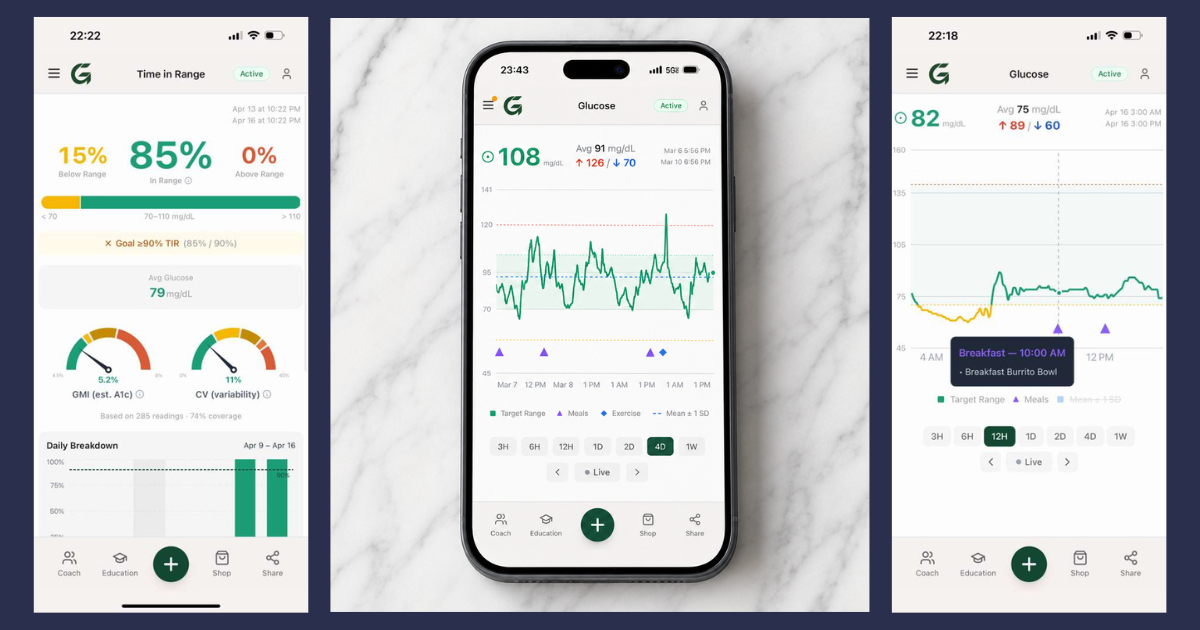
“If we’re going to make a clinical product, it’s got to work for the people who do the clinical work,” Ruby said.
Clinicians often know what they want patients to do, but they may not have an efficient way to monitor whether the plan is being followed or whether adjustments are needed.
“What happens is now the clinician gets this at a glance,” Ruby said. “It really helps them with the follow-up.”
For practitioners, Ruby said, the value is not just that food is delivered. It is that the program gives them a way to see whether the dietary intervention is being followed and how the patient is responding.
Through the app and portal, patients can track glucose, meals, exercise, weight and blood pressure. Ruby said the clinician can review the same information and use it to guide follow-up.
“They can see every patient that they have on this in their practice in one summary screen, and it’ll instantly show them who’s doing well, who’s not,” Ruby said.
That kind of visibility may be especially useful during the early transition to a ketogenic diet, when patients are often learning which foods work for them, how their glucose responds and where they may be drifting from the plan. Ruby said the system can also help clinicians review post-meal glucose responses and identify patterns that might otherwise be missed.
Ruby said the goal is to make nutrition easier to operationalize inside a practice. Instead of asking clinicians to manage every detail of food selection, meal planning and daily troubleshooting, the program gives them a structured intervention and a way to monitor progress.
“The provider doesn’t have to be so engaged in the daily struggle to get this person on the diet,” Ruby said.
He said that is what may make Glyvance appealing to clinicians who want to use nutrition more deliberately but do not have the time or infrastructure to manage every patient’s food decisions day by day.
“He’s got something that allows him to get adherence,” Ruby said. “He’s got something that lessens his workload and clinician burden, and then he’s got something that he can very easily measure progress on.”
The app also includes an AI coaching feature tailored to the program. Ruby gave the example of a patient at a restaurant taking a picture of a menu and asking which options are least likely to disrupt the goals of the program.
It is not the same as eating the provided meals, he said. But it may help patients stay close to the plan when life gets in the way.
“Life happens,” Ruby said. “The 90% solution is really important to keep the momentum and the progress going.”
A practical question for the low-carb community
Glyvance is currently in a beta launch, with patients applying for early access. Ruby said the company is scaling carefully as it builds the program.
The program is also aimed, at least initially, at a self-pay market. Ruby said the weekly cost is $550 plus shipping and tax, and he acknowledged that the price will limit access for some patients.
But the broader question Glyvance raises is relevant beyond one company.
If low-carbohydrate nutrition is going to reach more people, the field may need more than education and enthusiasm. It may need systems that make adherence easier, make progress more measurable and make clinical follow-up more efficient.
Some patients can follow a ketogenic diet on their own. They can shop, cook, track, adjust and sustain the process for months or years. Ruby believes many others need a different path.
“My question to the whole industry is, what tiny fraction of patients are we limiting ourselves to?” Ruby said. “The ones who can actively follow a DIY program themselves over the long term. It’s small.”
For a professional community already convinced that nutrition matters, that may be the next frontier: not just explaining the science, but building systems that help more people put it into practice.
Glyvance at the San Diego Symposium
Ruby and representatives from Medifoodz will be at the 2026 Symposium for Metabolic Health in San Diego, taking place Aug. 13-16 at the Wyndham San Diego Bayside. The four-day LowCarbUSA event will bring together clinicians, researchers and health-focused attendees for presentations on therapeutic carbohydrate reduction, metabolic health and metabolic therapies, including a special focus day on the metabolic roots of obesity and type 2 diabetes.
In-person attendees will also have an opportunity to experience one of the Glyvance meals. Ruby said Medifoodz will serve blackened chicken breast with cauliflower risotto and Parmesan cream, a dish made with blackened white meat chicken over cauliflower in Parmesan cream with shallot and garlic. The company also plans to offer its pistachio chocolate “craving reduction bites” at lunch and at its booth, along with orange-flavored electrolytes for attendees to try.