Dr. Robert Cywes Returns to San Diego Symposium: Why Treating Obesity Like a Math Problem Keeps Failing
For decades, obesity and type 2 diabetes have been framed as problems of discipline, math, and personal responsibility. Eat less. Move more. Count your calories. Stay consistent.
And yet, millions of people who are intelligent, motivated, and capable continue to struggle—often cycling through the same advice with diminishing returns.
Dr. Robert Cywes believes that’s not a coincidence. It’s a misunderstanding.
“The greatest challenge,” Dr. Cywes said, “is understanding that carbohydrates are not the problem—your relationship with them is.”
That shift—from food quantity to behavior—may explain why so many well-intentioned strategies fail, and why a different kind of conversation is beginning to take shape among clinicians and patients alike.
It’s also the foundation of a full-day focus on obesity and type 2 diabetes at the upcoming Symposium for Metabolic Health in San Diego this August, where Dr. Cywes will help lead the discussion.
Beyond Calories: A Different Model of Obesity and Diabetes
Dr. Cywes, a bariatric surgeon who has spent years treating patients with severe metabolic disease, no longer views obesity through the traditional lens of caloric balance.
Instead, he frames it as a behavioral and hormonal condition—one driven not just by what people eat, but why they eat.
“Type 2 diabetes,” he said, “is the consequence of a prolonged defense mechanism by the human body against a tsunami of sugar and starch.”
In that model, the body isn’t failing—it’s adapting.
“If the body can easily convert that excess sugar into fat, you become obese, but you don’t become diabetic,” he explained. “If the body cannot clear the sugar, your blood sugar goes up, and we call that type 2 diabetes.”
Two different outcomes. One underlying pattern.
And crucially, one that develops over time—not overnight.
“Nobody gains 50 pounds in two days. Nobody becomes diabetic on a vacation,” Dr. Cywes said. “So what we’ve got to look at is this is foundational to your way of life.”
That framing shifts the conversation away from short-term fixes and toward long-term patterns—patterns that are often deeply ingrained and reinforced over years.
Addiction, Behavior, and the Limits of Willpower
If obesity and type 2 diabetes are rooted in long-standing behavioral patterns, the next question becomes: why are those patterns so difficult to change?
Dr. Cywes’ answer is direct—and, for some, uncomfortable.
For many patients, he says, the issue is not hunger in the traditional sense. It’s a relationship with food that behaves much like addiction.
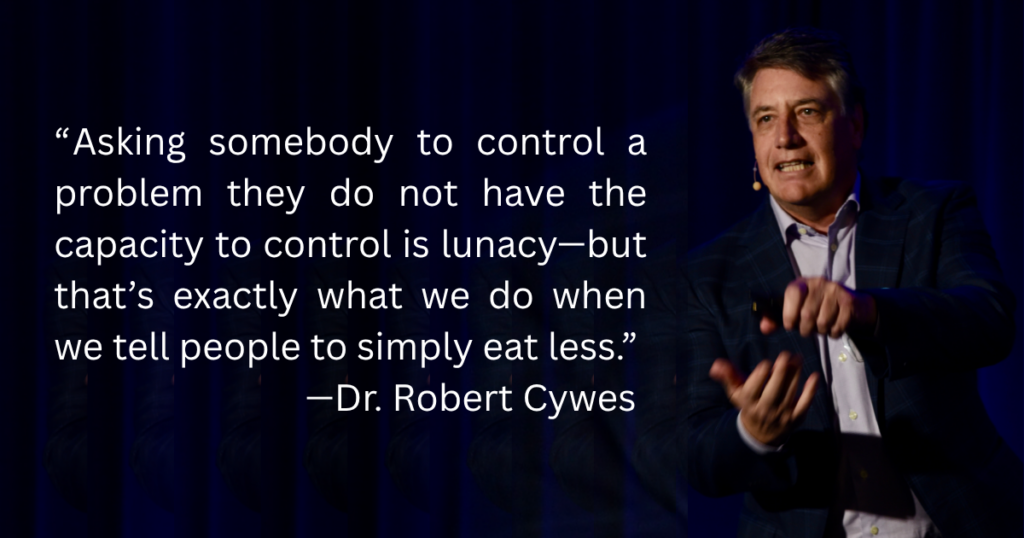
“Asking somebody to control a problem they do not have the capacity to control is lunacy,” he said.
That’s why strategies built around moderation often fail. They assume that individuals can simply regulate intake through discipline alone. But if the relationship itself is dysregulated, that assumption breaks down quickly.
“Addiction is predicated by the word permission,” Dr. Cywes said. “And once you grant yourself permission, by definition, addicts cannot control that.”
This is where the conversation moves beyond physiology into psychology—and where many patients begin to recognize their own patterns.
“You can’t break a habit you’re still doing,” he said. “You can only break a habit by not doing it over a protracted period of time.”
For some, that may mean gradually reducing carbohydrate intake. For others, it may require a more definitive shift. But in either case, the focus is not on perfection—it’s on changing the relationship itself.
Where Medications Fit—and Where They Don’t
At a time when GLP-1 medications like Ozempic and Wegovy are reshaping the landscape of obesity treatment, Dr. Cywes offers a perspective that is both pragmatic and nuanced.
“In my lifetime,” he said, “they are the single most effective treatment for the biggest problem that we have in the world, which is metabolic disease.”
But effectiveness does not mean completeness.
The concern, he explained, is not the medication itself, but how it’s used. When prescribed as a long-term solution without addressing the underlying drivers of behavior, it risks becoming another layer of management rather than a path to resolution.
“This is a marriage,” he said. “It’s a marriage between the changes you make and the assistance you get from your medication.”
In that sense, GLP-1s can serve as an accelerant—helping patients stabilize blood sugar, reduce appetite, and create space for change. But they are not a substitute for that change.
“Nobody takes Chantix and just hopes they quit smoking,” he said. “You make a commitment, and you use it to help you.”
A System Focused on Symptoms
Much of Dr. Cywes’ critique is not aimed at individuals, but at the broader system of care.
“Mainstream medicine,” he said, “is devoid of effective information on lifestyle change. They lead with medications to treat numbers.”
That approach can be effective in the short term, particularly for managing risk. But without addressing root causes—insulin resistance, behavioral patterns, dietary inputs—it often becomes a lifelong cycle of treatment.
Dr. Cywes advocates for a different model, one grounded in shared decision-making and individual awareness.
As a starting point, he suggests something simple: observe.
“You can wear a CGM. It always tells the truth,” he said, adding that tracking patterns over time—rather than focusing on isolated “good days”—can reveal far more about what’s actually driving outcomes.
“My job is to provide knowledge,” he added. “Your job is to make the decision.”
That includes understanding risks, benefits, and alternatives—and recognizing that there is no one-size-fits-all solution.
Why This Conversation Matters Now
The stakes are not theoretical.
Rates of obesity, type 2 diabetes, and related conditions continue to rise globally, despite increased awareness and expanding treatment options.
At the same time, the volume of information—particularly online—has grown exponentially.
“A lot of people… are getting their information either by advice that is not supported biologically or physiologically,” Dr. Cywes said, “or based upon somebody’s personal experience that doesn’t correlate with you as a patient.”
The result is confusion. Contradiction. And, often, frustration.
Which is why events like the Symposium for Metabolic Health have taken on increased importance.
Inside the Symposium: Science, Debate, and Real Conversations
For Dr. Cywes, the value of the symposium is not just the content, but the environment.
“This conference juxtaposes the massive tsunami of industry-sponsored noise in the healthcare space,” he said.
Unlike many traditional medical conferences, the focus here is not on reinforcing consensus, but exploring it.
“We will address our narrative to change based on the science,” he said.
That openness extends beyond the speakers. Attendees—clinicians, patients, and others—are encouraged to engage, question, and challenge ideas in real time.
“If there is expected consensus of opinion, that is a church,” Dr. Cywes said. “That is a religion. It is not science.”
The result is a rare kind of dialogue: one that is rigorous, sometimes uncomfortable, but ultimately productive.
The Role of the Society of Metabolic Health Practitioners
The symposium is closely tied to the work of the Society of Metabolic Health Practitioners, an organization Dr. Cywes has helped shape.
He describes it as a group of “like-minded people” who share a common goal: advancing the understanding and treatment of metabolic disease while remaining open to debate and new evidence.
“It’s all about consensus… rather than being distracted by the disparity,” he said.
The organization also serves as an advocacy group—supporting clinicians who may be working outside conventional guidelines and providing a foundation for continued research and collaboration.
“The more we stand together,” Dr. Cywes said, “the more we will benefit.”
An Invitation to Learn—and Reconsider
Dr. Cywes is quick to point out that the Symposium is not for everyone.
“If you think you know it all… you might as well just climb in your coffin right now,” he said.
But for those willing to question assumptions, explore new ideas, and engage in meaningful dialogue, the opportunity is significant.
“This is an opportunity to learn, to change your mind, and to consolidate the information that you do know about yourself,” he said.
And for those unable to attend in person, options to participate virtually or access recordings ensure that the conversation extends far beyond the room.
The Bigger Question
Ultimately, the conversation Dr. Cywes is advancing is not just about diet, medication, or even obesity itself.
It’s about how we think.
How we define problems.
How we interpret evidence.
And how willing we are to reconsider what we believe to be true.
Even those leading the conversation, he suggested, should be willing to keep learning.
“No matter how much you know, every day is an opportunity to get better,” Dr. Cywes said, describing himself not as an expert, but as a student. That mindset may be exactly what this field needs most.
Because if the current model were sufficient, the results would already be there.
And if it’s not, then the most important step may not be doing more.
It may be thinking differently.
Moving the Symposium Conversation Forward
Looking ahead, the conversation continues this summer at the 11th Annual San Diego Symposium for Metabolic Health, taking place August 13–16, 2026.
This year’s event will feature a special focus day devoted to understanding the metabolic roots of obesity and type 2 diabetes—bringing together leading clinicians, researchers, and practitioners for four days of education, collaboration, and practical, real-world insight.
For those following the work of Dr. Cywes and others in this space, it represents an opportunity to go deeper—to engage directly with the ideas, the debates, and the evolving science shaping the future of metabolic health.
The momentum carries into 2027 with the Symposium for Metabolic Health in San Antonio, scheduled for January 29–31, 2027, which will include a full day dedicated to food addiction—an increasingly important and often overlooked driver of metabolic disease.
Whether attending in person or accessing sessions online, these events continue to serve as a hub for advancing knowledge, challenging assumptions, and connecting a growing global community committed to changing the trajectory of chronic disease.