Siobhan Huggins Makes the Case for Therapeutic Carbohydrate Reduction as Part of a Holistic, Personalized Approach
At the 2026 Symposium for Metabolic Health in Boca Raton, Siobhan Huggins delivered a presentation that blended clinical rigor with something often missing in medicine: lived experience, empathy, and practical application.
Her talk was based on a recently published paper, Therapeutic Carbohydrate Reduction for Lipedema: Guidelines for a Patient-Centered, Holistic Approach, authored by Leslyn Keith, OTD, CLT, Certified Lymphedema Therapist (USA), Siobhan Huggins, Research Specialist with LS USA, and Carrie Reedy, BHSc, FNLP, Functional Nutritionist and Health Coach (Australia).
The presentation addressed a condition that remains widely misunderstood, frequently misdiagnosed, and deeply impactful for those who live with it.
“Lipedema is a disorder that impacts the fat tissue and connective tissue… it’s often misdiagnosed as obesity,” Huggins explained.
That misdiagnosis, she emphasized, is not a minor issue. It can delay care, worsen outcomes, and leave patients feeling dismissed.
A misunderstood condition hiding in plain sight
Despite growing awareness, lipedema remains underrecognized in clinical settings.
“I guarantee that the doctors and coaches in the audience—you have people in your clinic who have lipedema, and you are not aware of it,” Huggins said.
If estimates are correct, lipedema may affect millions of women in the United States alone, with some research suggesting an incidence as high as one in nine adult women. That estimate comes from a 2016 paper titled “Lipedema: A Relatively Common Disease with Extremely Common Misconceptions,” underscoring just how widespread—and underdiagnosed—this condition may be.
The condition presents with distinctive features: disproportionate fat accumulation—typically in the lower body—paired with pain, swelling, and tissue changes that do not respond to conventional approaches like calorie restriction or exercise. Patients often describe their experience in visceral terms.
“My legs feel really heavy, like they’re made of concrete… they feel so tight, they could be bursting,” Huggins said, describing common patient reports.
Unlike simple weight gain, the affected tissue can be physically painful—sometimes severely so—and resistant to traditional interventions.
Why carbohydrate reduction matters
Huggins and her collaborators—Leslyn Keith and Carrie Reedy—set out to answer a practical question: how can clinicians effectively help these patients?
Their answer centers on therapeutic carbohydrate reduction, particularly ketogenic diets. The evidence, she noted, is both growing and consistent.
“The main findings that we see are reduced symptoms, particularly in relation to pain… improved body composition… improved metabolic health… improved quality of life,” Huggins said.
Perhaps most compelling, these outcomes are not limited to clinical trials.
“These are all findings from studies… but they align with real-world outcomes… reported in lipedema support groups and by clinicians,” Huggins said.
In a condition where traditional approaches often fall short, that alignment between research and lived experience carries significant weight.
Bridging a dangerous knowledge gap
One of the driving forces behind the paper was a disconnect Huggins observed firsthand.
At the Lipedema World Congress, she found broad agreement that ketogenic diets could be helpful, but also hesitation about using them long term. Much of that hesitation, she suggested, stems from incomplete or siloed information.
“Information from much of the influential ketogenic research… appeared to be trapped in a silo, and it wasn’t reaching this community,” Huggins said.
Concerns ranged from nutrient deficiencies to cardiovascular risk—topics that have been widely debated in other areas of metabolic health. Rather than dismissing those concerns, the paper addresses them directly, offering clinicians a framework for monitoring, adjusting, and personalizing care.
Why “just go low-carb” isn’t enough
If carbohydrate reduction is effective, why not simply recommend it and stop there?
Huggins made it clear that the answer lies in the complexity of both the condition and the patient.
“Why not just say, ‘keep your carbs low… and leave the rest up to you’?” Huggins asked.
The paper introduces a holistic framework that extends far beyond nutrition, incorporating physical health, emotional readiness, psychological factors, and social environment. Lipedema is not a short-term problem, and the approach cannot be short-term either.
“This is a situation… of managing over the long term, over a lifetime, which means anything you do has to be something they can sustain,” Huggins said.
Personalization: three patients, three paths
Huggins emphasized that no two patients present the same way, and treatment should reflect that.
“All of these people are different, and we want to accommodate these differences in their different needs,” Huggins said.
An early-stage patient may benefit from moderate carbohydrate reduction and a whole-food approach. Someone with insulin resistance may require a more structured, lower-carbohydrate strategy. Another patient, dealing with severe and persistent pain, may be motivated to adopt a more intensive ketogenic or even carnivore-style approach to achieve faster relief.
This is not a rigid protocol—it is a framework for clinical decision-making.
The emotional and psychological reality
Beyond physiology, Huggins highlighted the emotional burden carried by many individuals with lipedema.
“They’ve been through this exact song and dance… and they do not want to encounter that heartbreak again,” Huggins said.
Many patients arrive skeptical and exhausted, having tried multiple approaches without lasting success. Others may be navigating anxiety, depression, or disordered eating patterns, all of which can influence adherence and outcomes.
“Do they have the tools to succeed?… If they struggle with emotional eating, we need to figure out if they have other avenues to de-stress,” Huggins said.
Addressing these factors is not optional—it is essential.
The social barrier—and the hidden advantage
Dietary change does not happen in isolation. Social dynamics—family, culture, and environment—can either support or undermine progress.
“Potlucks, restaurants, well-meaning grandmas… these can be huge roadblocks to success,” Huggins said.
At the same time, those same social forces can become powerful assets when aligned with the patient’s goals. Support groups, particularly those specific to lipedema, can provide validation, practical advice, and a sense of belonging.
“They’re getting support… congratulations… and a shoulder to cry on with people who understand what they’re going through,” Huggins said.
What success actually looks like
Huggins emphasized the importance of setting realistic expectations. While physical appearance may not fully normalize, meaningful improvements are often seen in symptoms and quality of life.
Patients frequently report reductions in pain, improvements in mobility, and a renewed sense of control over their condition.
In some cases, the transformation can be dramatic.
“We have seen people… bedbound, wheelchair bound… transform—pain free… interacting with their community again… filled with hope,” Huggins said.
A call to clinicians: curiosity over perfection
Huggins closed with a message that resonated across disciplines.
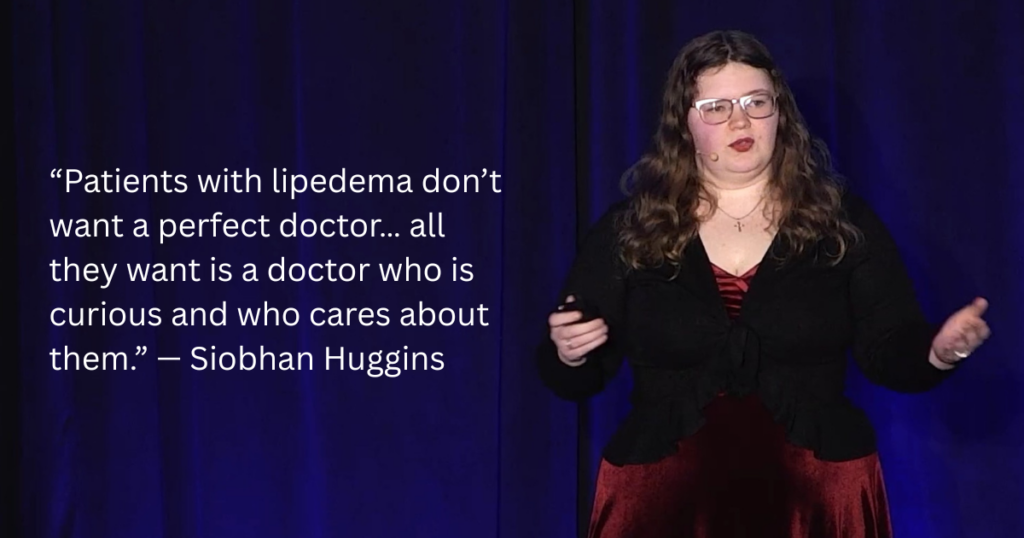
“Patients with lipedema don’t want a perfect doctor… all they want is a doctor who is curious and who cares about them,” Huggins said.
For a condition that remains underdiagnosed and often misunderstood, that mindset may be the most important starting point. Progress will not come from a single intervention, but from clinicians willing to learn, adapt, and engage.
“I think it is possible. I think we can do this,” Huggins said.
To hear Huggins describe this in her own words—and the real-world transformations she has seen—watch this short clip from her presentation:
“Patients with lipedema don’t want a perfect doctor… all they want is a doctor who is curious and who cares about them,” Huggins said.
Continue the Conversation at the Symposium for Metabolic Health
If you missed the 2026 Symposium for Metabolic Health in Boca Raton, it’s not too late to access the full experience. Recordings from every presentation—including Siobhan Huggins’ talk—are available for purchase, along with 22 optional CME credits for qualified professionals. This provides an opportunity to revisit key sessions, dive deeper into the material, and continue learning at your own pace.
Looking ahead, the conversation continues this summer at the 11th Annual San Diego Symposium for Metabolic Health, taking place August 13–16, 2026. This year’s event will feature a special focus day devoted to understanding the metabolic roots of obesity and diabetes, bringing together leading clinicians, researchers, and practitioners for four days of education, collaboration, and practical insights.
The momentum carries into 2027 with the Symposium for Metabolic Health in San Antonio, scheduled for January 29–31, 2027. This conference will include a full day dedicated to food addiction—an increasingly important and often overlooked driver of metabolic disease.
Whether you’re joining in person or accessing sessions online, these events continue to serve as a hub for advancing metabolic health knowledge and connecting a growing global community committed to changing the trajectory of chronic disease.