Upcoming LowCarbUSA presenter will discuss a pilot study comparing a well-formulated ketogenic diet with American Diabetes Association-style meals in people with type 1 diabetes, type 2 diabetes and prediabetes
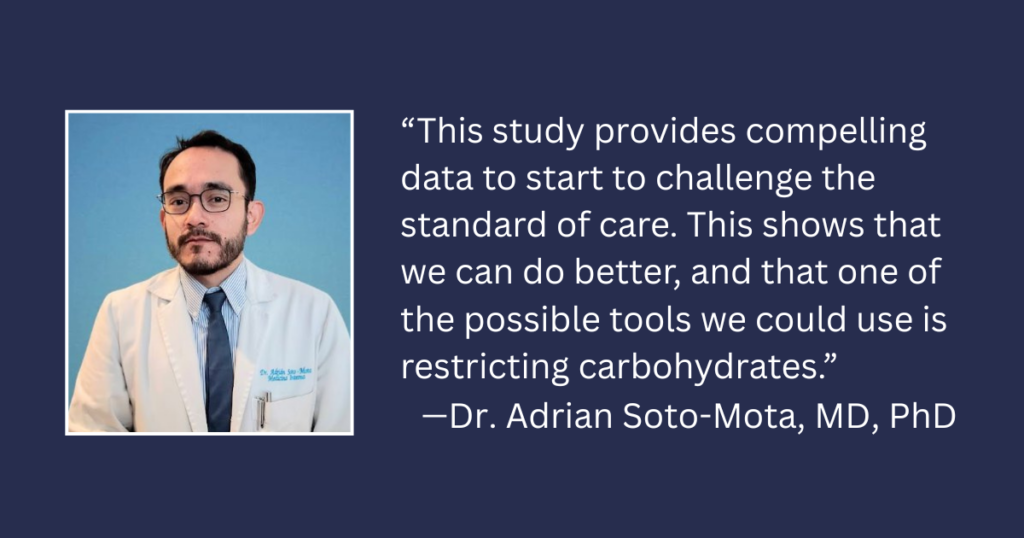
When Dr. Adrian Soto-Mota takes the stage at the 2026 Symposium for Metabolic Health in San Diego, his presentation will center on a question that matters deeply to clinicians, researchers and patients: Can we do better than the current standard of care for diabetes?
Dr. Soto-Mota, MD, PhD, FACP, is among the confirmed speakers for the Aug. 13-16 event, hosted by LowCarbUSA in collaboration with the Society of Metabolic Health Practitioners at the Wyndham San Diego Bayside Hotel.
The conference will feature leading voices in metabolic health, therapeutic carbohydrate reduction, diabetes, obesity, cardiovascular risk, nutrition science and clinical practice.
For Dr. Soto-Mota, the topic is more than theoretical. He is both a researcher and a practicing physician who sees private patients and hospitalized patients while teaching internal medicine residents.
His San Diego presentation, tentatively framed as “ketogenic intervention versus standard of care,” will focus on a paper currently in peer review involving door-delivered meals for people with type 1 diabetes, type 2 diabetes and prediabetes.
“The core of what I will present is the results of a paper that currently is in peer review that involved door-delivered ketogenic diet,” Dr. Soto-Mota said in a recent interview. “We are comparing that versus door-delivered American Diabetes Association diet.”
A Head-to-Head Comparison Using Continuous Glucose Monitors
The study was designed as a pilot, and Dr. Soto-Mota is careful not to overstate its conclusions. It was short term, involved a small sample size and was not intended to settle every question about dietary treatment for diabetes.
Still, the setup is compelling.
Participants with type 1 diabetes, type 2 diabetes and prediabetes wore continuous glucose monitors for two weeks. One dietary arm received a well-formulated ketogenic diet with less than 50 grams of total carbohydrates per day, with the mean intake around 32 grams per day. The comparison arm received meals based on menus from the American Diabetes Association website, also delivered to their doors.
Dr. Soto-Mota emphasized that this was not a comparison against poorly controlled patients eating whatever they happened to eat at home. Many participants were already doing well by conventional glucose metrics.
“We studied a well-controlled population of people with type 1 diabetes, type 2 diabetes and prediabetes, most of whom were already spending more than 90% of their time within the therapeutic range,” Dr. Soto-Mota said. “They were well-controlled people who, on top of that, were eating meals recommended by the American Diabetes Association.”
That makes the comparison more interesting. If people are already “well controlled” by standard measures, there is less room for dramatic improvement.
Dr. Soto-Mota described it as “a very steep battle against the standard of care.” Yet, he said, the carbohydrate-restricted diet still showed additional benefit.
“Even in those who are well controlled, following every medication recommended by guidelines, and following the diet recommended by the American Diabetes Association, they do even better when they are on a carbohydrate restrictive diet,” he said.
A Study About Food, But Also About Adherence
One of the most practical aspects of the study is that both groups received meals delivered to their homes. That matters because Dr. Soto-Mota believes much of the challenge in dietary change is not simply knowledge. It is implementation.
“When you try to change your dietary pattern, you need to rethink what you buy in the supermarket or what you order at home,” he said. “When you change your dietary pattern, you need to suddenly make lots of micromanagement decisions, and this overwhelms people.”
That observation should resonate with both practitioners and laypeople. Many patients are told what to do, but not given a practical path for doing it. They may leave a medical appointment with a handout, a calorie target or a vague instruction to “eat better,” but little help navigating real meals, real schedules and real decision fatigue.
Dr. Soto-Mota said the findings suggest more research is needed on interventions that facilitate adherence, whether to carbohydrate restriction or to other dietary strategies.
“This prevents lots of people from benefiting from something that could really help them,” he said.
The implication is clear: A dietary intervention is only as useful as a patient’s ability to follow it. For clinicians, that means the future of metabolic care may depend not only on better science, but also on better systems of support.
Challenging the Standard of Care Without Overstating the Case
Dr. Soto-Mota is careful with language. He repeatedly described the study as a pilot and said it is not large enough to make definitive claims.
But he also believes it raises serious questions.
“This provides compelling data to start to challenge the standard of care,” he said. “This shows that we can do better than the standard of care, and that one of the possible tools we could use to improve the standard of care is restricting carbohydrates.”
For attendees of the San Diego Symposium, that is likely to be one of the central takeaways. Dr. Soto-Mota is not presenting carbohydrate restriction as a slogan or identity. He is presenting it as a clinical tool that deserves serious consideration, particularly in a population where glucose regulation is the central problem.
“I do believe that the first step in the standard of care of anyone struggling with diabetes, prediabetes should be restricting carbohydrates,” he said. “Even when our study is not large enough to make that definitive claim, it certainly suggests we can start challenging the standard of care.”
That kind of nuance is part of what makes Dr. Soto-Mota’s work valuable. He is willing to challenge the prevailing model, but he also insists on precision, humility and careful interpretation.
‘I Arrived Here Through the Library’
Many people in the low-carb and ketogenic community come to the field through personal illness, a health crisis or the transformation of a family member. Dr. Soto-Mota said his path was different.
“I did not arrive here fighting an illness,” he said. “I arrived here through the library.”
His original plan was to become a neurologist. But as he began educating himself in nutrition, he realized how little nutrition had been included in his medical training.
“I had a very typical medical education with zero hours of nutrition,” he said. “When I started educating myself in nutrition, I realized how misinformed I was about nutrition. How misinformed most patients are about nutrition.”
That realization changed the direction of his work.
“I like feeling useful for others,” Dr. Soto-Mota said. “So I realized that nutrition sciences is a field where I could add value.”
That statement captures much of what makes his San Diego talk relevant beyond academic interest.
He is not merely asking whether a ketogenic intervention can improve CGM metrics. He is asking whether medicine has overlooked practical tools that could help large numbers of patients.
The Lean Mass Hyper-Responder Connection
Dr. Soto-Mota is also known for his work with Dave Feldman, Nick Norwitz, PhD, and others in the Lean Mass Hyper-Responder research space. The LMHR phenotype generally refers to lean, metabolically healthy individuals who experience large LDL cholesterol increases on carbohydrate-restricted diets, often alongside high HDL cholesterol and low triglycerides.
Dr. Soto-Mota’s connection to the story began before he knew Feldman personally. He first met Norwitz at Oxford, where both completed their PhDs in the physiology department. At the time, Norwitz was not yet known for ketogenic diet research.
“When I met Nick, Nick was very far from eating a ketogenic diet,” Dr. Soto-Mota said. “One of the best things that happened to you was Nick baking for you. He is a wizard with flour and with refined carbs.”
Norwitz had even developed a reputation among friends for a dessert he called “Welcome Back Lava,” which Dr. Soto-Mota described as having “an insane amount of sugar.” The detail is a small but revealing piece of history, given how closely Dr. Soto-Mota, Norwitz and Feldman are now associated with research into low-carbohydrate diets, lipid metabolism and the Lean Mass Hyper-Responder phenotype.
Dr. Soto-Mota learned about Feldman later, through Feldman’s appearance on Peter Attia’s podcast. As he listened to Feldman describe his cholesterol observations, Dr. Soto-Mota realized he had the ability to test similar observations in himself.
“I also knew how to follow a ketogenic diet,” he said. “I was also lean and metabolically healthy, and I had access to point of care tools.”
He replicated the observations in himself and initially filed them away as “a curious physiological observation.” Later, after Norwitz adopted a ketogenic diet and observed a similar lipid pattern in himself, the collaboration deepened. Dr. Soto-Mota said Norwitz reached out when he and Feldman were analyzing cholesterol survey data because of Dr. Soto-Mota’s interest in statistical analysis.
Since then, Dr. Soto-Mota has continued collaborating in the LMHR space. But he is clear that the controversy around LDL cholesterol, ketogenic diets and cardiovascular risk requires careful discussion rather than slogans from either side.
Carbohydrate Restriction as a Tool, Not an Ideology
One of Dr. Soto-Mota’s strongest messages is that carbohydrate restriction should be understood as a therapeutic tool, not a tribal identity.
“In my mind, carb restrictive diets are simply another tool, another therapeutic tool,” he said. “The same way I don’t think all my patients need a particular antibiotic, I don’t think all my patients need restricted carbohydrates.”
That framing is especially important for practitioners who are skeptical of diet labels or wary of rigid claims. Dr. Soto-Mota is not arguing that every patient needs the same diet. He is arguing that clinicians should be willing to use safe and effective tools when they fit the patient in front of them.
“We need to stop discussing label diets,” he said. “This is not about showing the ketogenic diet is the best diet. This is about helping the person in front of me.”
Why the SMHP Matters
Dr. Soto-Mota also sees an important role for the Society of Metabolic Health Practitioners at this stage in the evolution of metabolic medicine.
“I think that these types of groups are especially useful at a stage like the one we find ourselves in this field right now,” he said. “They facilitate networking for patients and care providers, because they accelerate the production of evidence to eventually change standard of care.”
He said organizations such as The SMHP can help standardize education, create opportunities for peer support and accountability, and present stronger versions of the arguments for therapeutic carbohydrate reduction and metabolic health interventions.
“The educational purpose they provide is valuable in itself,” Dr. Soto-Mota said. “To have something to present the steel man version of these arguments, not the straw man version.”
That distinction matters. In nutrition debates, people often argue against caricatures. Low-carb diets are reduced to bacon and butter. Conventional lipidology is reduced to blind medication-first thinking. Social media rewards conflict more than clarity.
Dr. Soto-Mota said he has seen “reductionistic thinking on both sides of the aisle,” and noted that some clinicians become skeptical because they have only been exposed to poor versions of the argument for carbohydrate restriction.
For clinicians trying to practice responsibly, The SMHP offers a professional community where these questions can be discussed with more rigor, nuance and accountability.
Learn more about the Society of Metabolic Health Practitioners here and join today.
A Symposium for Better Conversations
Dr. Soto-Mota’s upcoming presentation should appeal to practitioners who want to better understand the evidence base for carbohydrate restriction, patients who want to better understand diabetes and glucose control, and anyone interested in how metabolic medicine may evolve beyond the current standard of care.
His message is not that every person needs a ketogenic diet. It is that clinicians should be open to using carbohydrate restriction where it makes sense, researchers should keep asking better questions, and professional communities should help turn clinical experience into better evidence and better care.
That is one reason he values gatherings such as the Symposium for Metabolic Health. In an era when many scientific and medical debates play out on X, podcasts and comment threads, Dr. Soto-Mota said he has become less convinced that social media is the right place for meaningful disagreement.
“Social media is not a good substitute for actually having conversations, and the best conversations occur in person,” he said.
The San Diego Symposium is not simply a place to hear lectures. It is a place where researchers, clinicians, health coaches, patients and advocates can challenge assumptions, sharpen their thinking and have the kinds of conversations that are hard to reproduce online.
“I have learned a lot in conferences like this,” Dr. Soto-Mota said. “Many collaborations have originated in conferences like this, but most of all I go for the opportunity of having a better feedback and communication channel about these ideas than what we can get in other formats.”
Learn more about the San Antonio Symposium in January 2027 or the Boca Raton Symposium in January 2028.