Doug Reynolds and Pam Devine join I Fix Hearts Employee Wellness Livestream to discuss upcoming August event
When Doug Reynolds and Pam Devine founded LowCarbUSA in 2015, they were not trying to build a movement. They were trying to understand why the standard advice they had followed for years was not working.
Both were active. Doug had a long history as a marathon and ultramarathon runner. Pam had worked in radiology and was deeply familiar with conventional health care settings. They were running, training, practicing martial arts and trying to eat what they believed was a healthy diet.
Still, both were gaining weight and struggling with energy.
“We were more active than a lot of people that we knew, especially in our office, and we were still putting on weight,” Pam said during a recent IFixHearts Telemedicine employee wellness livestream hosted by Krisna Hanks, director of employee wellness. “We thought we were eating healthy. We thought we were following advice.”
That personal experience eventually led them to the work of researchers and clinicians such as Stephen Phinney and Jeff Volek, Tim Noakes, and to the broader field of low-carbohydrate and ketogenic nutrition.
It also led to the first LowCarbUSA conference in San Diego in 2016.
“I was 52 at the time, and it was like, how is it that I didn’t know about any of this?” Doug said. “We need to provide an opportunity to teach other people about what we didn’t know.”
Ten years later, LowCarbUSA has hosted more than two dozen events and helped create one of the most important meeting places for clinicians, researchers, health coaches and members of the public interested in therapeutic carbohydrate reduction and metabolic health.
Its next major gathering, the Symposium for Metabolic Health in San Diego, is scheduled for Aug. 13-16, 2026. This year’s event will include a dedicated focus day on obesity and type 2 diabetes.
A full day on obesity and type 2 diabetes
LowCarbUSA began adding focus days to its conferences several years ago, starting with food addiction. The format allowed one day of the event to go deeper on a major topic, rather than touching on it briefly in different isolated lectures.
Since then, LowCarbUSA has hosted focus days on topics including food addiction, cancer, type 1 diabetes, mental health, women’s health, and neurological conditions.
Now the organization is turning a spotlight on what Doug called one of the most obvious and urgent topics in metabolic health: obesity and type 2 diabetes.
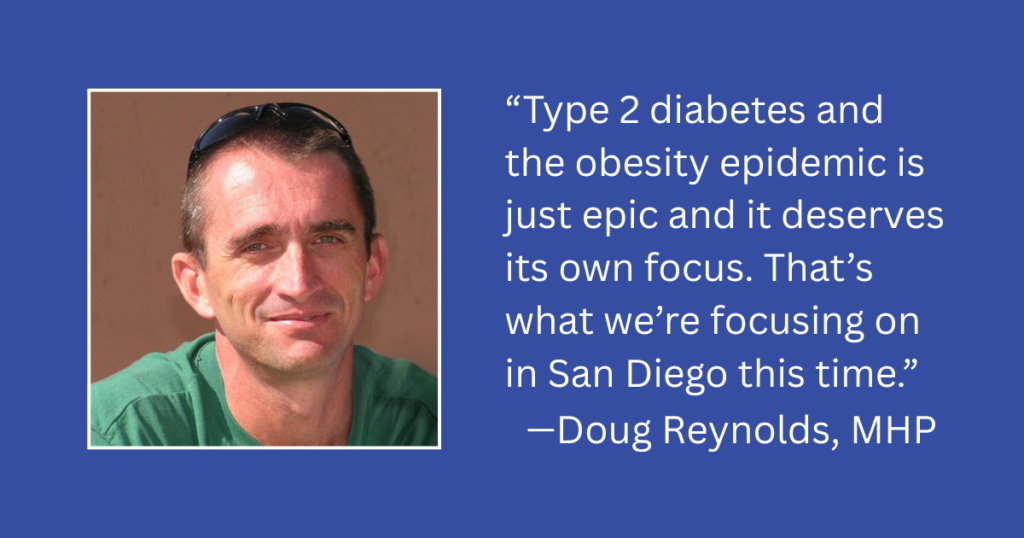
“Type two diabetes and the obesity epidemic is just epic, and so it deserves its own focus,” Doug said. “That’s what we’re focusing on in San Diego this time.”
The San Diego Symposium is a four-day event, meaning the obesity and type 2 diabetes focus day will be part of a broader program featuring more than 20 expert presenters across a wide range of metabolic health topics.
Doug said the full speaker schedule and focus-day lineup are still being finalized, but he highlighted several expected or likely contributors, including Dr. Robert Cywes, Dr. Robert Kiltz, Dr. Tony Hampton, Gary Taubes, Adrian Soto-Mota and Dr. Brian Lenzkes.
Doug said Cywes, a bariatric surgeon who often speaks about addiction and obesity, made a point years ago that has stayed with him.
“He said, ‘No one ever died from being fat,’” Doug said. “They die from the underlying conditions that manifest themselves as a result of their not being able to process their diet, and the obesity is just a sign of that.”
That framing gets to the heart of the San Diego focus day. The goal is not simply to talk about weight. It is to examine the underlying metabolic dysfunction that often drives obesity, type 2 diabetes, cardiovascular disease and other chronic conditions.
Moving beyond weight-loss contests and calorie-counting
During the livestream, Krisna noted that many workplace wellness programs have historically focused almost entirely on weight, often through calorie-counting challenges or “Biggest Loser”-style competitions.
Pam said that misses the deeper problem.
“Putting on weight is just a symptom of not being able to handle the food that’s coming in, high in sugars and carbohydrates, and high in processed foods” she said. “It’s not necessarily a math problem.”
She pointed to the modern food environment as one reason people often struggle to control intake.
“This is not your fault, that you can’t control certain things that you eat because our food companies are making it and processing it in a way that makes it hyper-palatable, so you can’t stop eating it,” Pam said.
For Pam, the better question is not how to blame people for eating too much, but how to help them understand what foods restore satiety, energy and metabolic stability.
“Let’s teach people what they can eat that makes them feel like they don’t want to just keep eating more of it,” she said.
That message is central to LowCarbUSA’s broader mission.
The organization promotes education around therapeutic carbohydrate reduction, real food, metabolic health markers, insulin resistance and the clinical application of low-carbohydrate strategies and a wider range of influences including muscle movement, resistance training, stress reduction, and better sleep and more for improved metabolic health.
Why employers should pay attention
Because the livestream was part of IFixHearts Telemedicine’s employee wellness series, Hanks asked Doug and Pam how employers might benefit from understanding metabolic health.
Pam said the workplace is one of the most important settings for this conversation.
“If the employer could think about how much time is lost when people are sick – they’ve got joint pain, they are getting sick more often, they don’t feel well, and they’re missing work and they’re not as productive,” she said. “So if they can start thinking about how much more productive their employees could be, how much better quality of work could be done, and that employee having a better quality of life.”
She said one simple place to begin is the break room, where employees trying to improve their health are often surrounded by donuts, bagels, muffins, cookies and cake.
“How often do people struggle at work if they’re trying to eat healthy, and they get to the break room and they’ve gotta go like this?” Pam said, describing the effort to avoid tempting foods. There’s always a holiday or birthday also, so “Let’s keep the conversation going about how to celebrate these events and still have less sugar and more protein in our diet for celebrations.”
Doug said individual employees can be inspired by a conference, but the real opportunity comes when business leaders decide to make metabolic health part of the culture.
“Having a boss who’s going to introduce a program in the company to try to change things for all the employees, that’s huge,” he said.
The role of the Society of Metabolic Health Practitioners
The livestream also touched on the Society of Metabolic Health Practitioners, the nonprofit organization closely connected to LowCarbUSA’s mission.
Doug said the SMHP was created to provide a professional home for physicians, NP’s PA’s, RN’s, dietitians, health coaches and other practitioners who use therapeutic carbohydrate reduction and broader metabolic health interventions in practice, or want to learn.
“We didn’t want to call ourselves the ketogenic society or something like that… that painted us into that corner,” Doug said. “There’s just so much more to metabolic health than just diet. It’s a huge part of it, but it’s not just diet.”
The SMHP offers membership, practitioner listings and accreditation pathways that allow qualified clinicians and coaches to earn the Metabolic Health Practitioner designation.
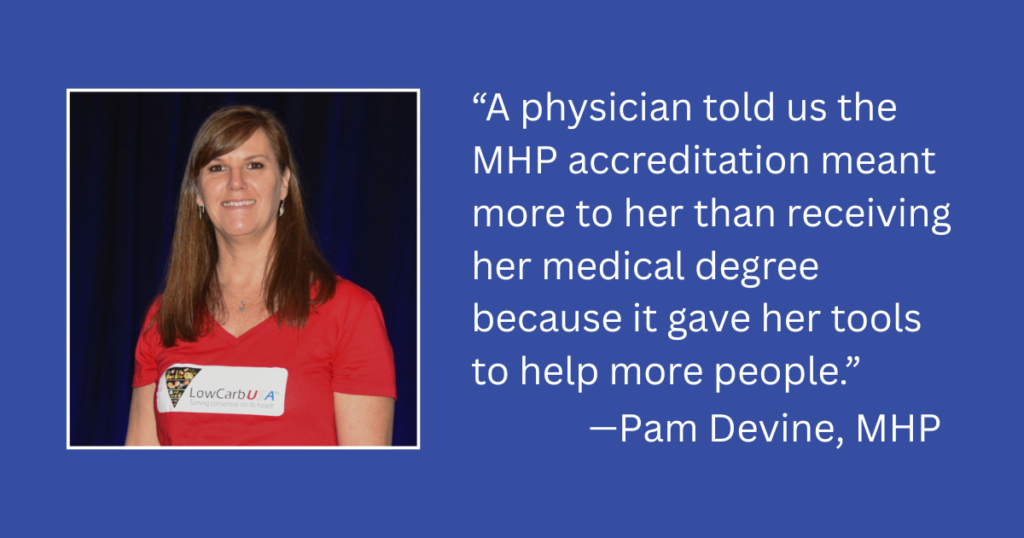
Pam said one early accreditation application still stands out. “A physician told us the MHP accreditation meant more to her than receiving her medical degree because it gave her tools to help more people.”
“I get a little bit teary, actually, every time I think about that,” Pam said. “There are doctors and nurse practitioners and physician assistants, all the people who work in health care, nurses and dietitians, that feel like they’re running on a treadmill, and there’s patients that come to their doctor and things aren’t helping them enough.”
For Pam, that is the heart of the work.
“We’re really looking forward to effective medical care for the patient and for the clinician, because they’re getting burned out,” she said. “They’re not getting to be able to do what they’ve gone into medicine to do, and that is to help more people feel better and have better health and spend less money on medications and enjoy their food and their family and their community.”
Why being there matters
For people considering the San Diego Symposium, both Doug and Pam emphasized that the livestream option is valuable, but the in-person experience is different.
“If there’s any way that you can make it, swing it so that you can get the time,” Doug said. “There is no comparison to being there.”
Pam said people who are new to the low-carb and metabolic health community should not feel intimidated.
“If you have never been and you don’t know anybody in the space, everybody is really very welcoming,” she said. “You’ll notice that a lot of us know each other because we’ve been working together for many years. People come year after year, but there’s new people that come and feel very welcome every time.”
The San Diego event also includes networking opportunities and low-carb VIP dinners designed to help attendees connect with speakers, practitioners and others who share similar goals.
“Those VIP dinners in the evenings are really hard to explain, but it’s all low carb, cooked by a chef,” Pam said. “You don’t have to worry about adjusting your menu, and you can sit down and share journeys with other people.”
For LowCarbUSA, the point of the conference is not simply to present information. It is to connect people who are trying to change the future of chronic disease care.
That includes researchers, clinicians, health coaches, employers, patients and people who simply know there has to be a better answer than telling people to eat less, move more and manage decline.
As Pam put it, the mission is still simple: reach more people.
“Come on the livestream if you can’t do anything else,” she said. “But if you’re on the fence about coming, please come and join us.”
Learn more and register for the 2026 San Diego Symposium for Metabolic Health here.