
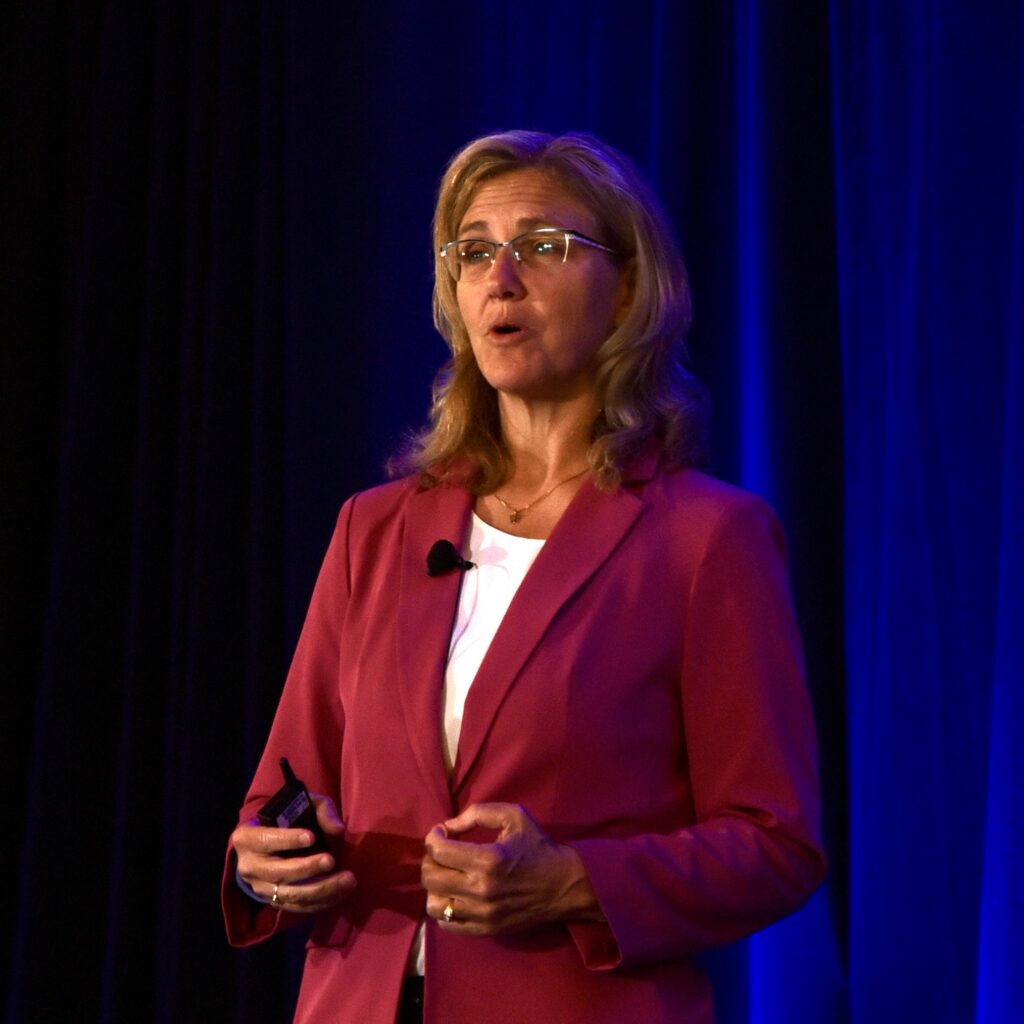
Denise Potter, RDN, CDCES has spent nearly two decades on the front lines of Ketogenic Metabolic Therapy (KMT)—long enough to see what happens when an underused therapy finally meets the people who need it. Founder of Advanced Ketogenic Therapies (AKT) and a global educator behind the collaborative Keto Mastery courses, Denise has trained clinicians around the world and helped families navigate the most personal decisions of care. Her work spans epilepsy, brain health, metabolic psychiatry, cancer, and more; she has held an integral role at The Charlie Foundation, and was the inaugural recipient of the Baszucki Brain Research Fund’s Metabolic Mind Award, and is the author of The Migraine Diet: A Ketogenic Meal Plan for Headache Relief.
Rediscovering a Century-Old Therapy
At our 10th Annual San Diego Symposium for Metabolic Health this past August, Denise delivered one of those talks that makes you lean forward in your chair. She opened with a clear thesis: ketogenic therapy for epilepsy is not an obscure hack; it’s a century-old medical strategy that remains, too often, out of reach.
“We don’t want keto to be considered the choice of last resort anymore, and it’s not supposed to be,” she said—reminding us the statistics for epilepsy worldwide, and in the US, effecting nearly one percent of the population – and that for the 30–38% of patients whose seizures don’t respond to medication, dietary therapy can be life-changing.
Denise walked through the “why” with the calm of a clinician who has watched it work: reduced brain excitability, more GABA (the brain’s calming chemical), less glutamate (the excitatory one), stronger mitochondria, and meaningful gut–brain effects. She cited research showing that ketogenic therapy can lower glutamate more than some antiseizure medications—a clue to why people who have failed multiple drugs still respond when the diet is implemented correctly.
Stories That Bring the Science to Life
The data was powerful—but the stories were unforgettable. Denise told of a first-grader we’ll call Emily, who was collapsing in class with drop seizures hundreds of times a day. After being told it would take up to a year to access a formal program, her mother started the ketogenic diet on her own. When Denise’s team joined, they adjusted the plan and monitored her progress weekly. Within three months, Emily’s seizures had nearly vanished. She now plays soccer. Her mother wrote, “I got my kid back.”

Not every case is pediatric. Denise described an adult with drug-resistant epilepsy who was losing entire weeks to post-seizure exhaustion. On a modest ketogenic plan—nothing extreme—her seizures dropped from 7–11 per month to 0–2 within three months. Her blood ketones were mild, but her quality of life was transformed.
If you came expecting a one-size-fits-all formula, Denise quickly dispelled that.
“There’s no keto in a box,” she said.
In her practice, she often starts adults around a 1.5:1 fat-to-(protein + carb) ratio, adds MCT oil slowly to avoid stomach upset, and lets symptom improvement guide each step. Some patients weigh meals at first to learn portion sizes; others work from structured targets and weekly coaching. The key is consistent support for at least three to four months—long enough for the brain to heal and adapt.
Making Ketogenic Therapy Accessible
Denise made clear that safety and oversight matter. The side effects are usually manageable: mild constipation that’s easy to correct, rare kidney stones when people stay well-hydrated, and temporary changes in cholesterol that need to be interpreted in context. Children with certain genetic conditions may need extra monitoring for bone health. What matters most, she emphasized, is team-based care—a neurologist, a trained dietitian, and routine lab work to keep everything on track.
So why isn’t this therapy more widely available? Denise pointed to access, not evidence. Despite strong clinical guidelines for both children and adults, there are too few centers and too little training to meet demand. Insurance coverage remains inconsistent, leaving many families to navigate alone.
“We have to demand this therapy for our patients with epilepsy,” she said. “It’s appropriate, it’s medically proven, and it’s scientifically sound.”
That means introducing ketogenic therapy earlier for people whose seizures don’t respond to medication—and using it as a first choice for conditions where it’s already recognized as essential, such as GLUT1 deficiency and PDH deficiency.
If you missed San Diego, you can still watch Denise’s full presentation—complete with case studies, Q&A, and practical guidance on diet ratios, MCT use, and meal strategies.
Watch or re-watch Denise’s talk, and the entire 2025 San Diego Symposium (optional CME credits available):
➡️ Get the San Diego recordings
And join us in person next year:
Boca Raton Symposium for Metabolic Health — January 23–25, 2026
An entire day of this Symposium will be dedicated to cardiovascular conditions.